Summer Nostalgia

Nostalgia: a sentimental longing or wistful affection for the past, typically for a period or place with happy personal associations.

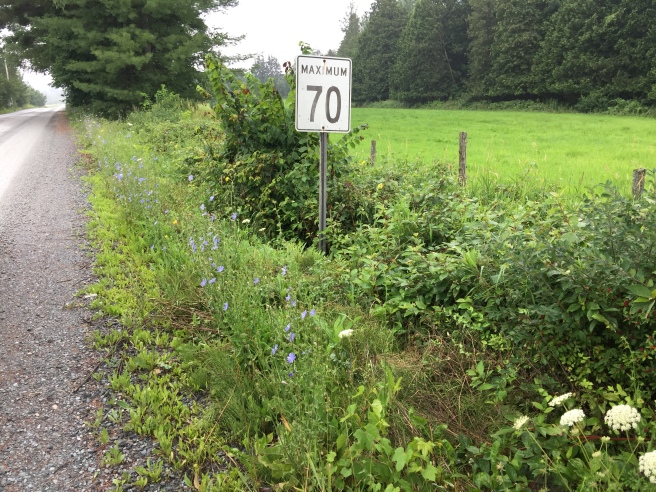
There is something about the quietness and warmth of mid-summer that brings reminiscences of summers past to the forefront for me. It happened the other day when I passed the chicory and Queen Anne’s Lace flowering on the roadside as we drove the backroads in the area near where I grew up.

IMG_2893.JPG

For a fleeting instant, I was sixteen or eight again out for a summer drive, windows down, bare suntanned feet pressed into the seat in front of me. Nostalgia has a way of grabbing an experience from the air at just the moment when life felt peaceful, or joyful, or special in some way and freezing it in time.

The word nostalgia is made up of two parts from the Greek: nóstos meaning “homecoming” and álgos meaning “pain” or “ache”. The ache part of nostalgia perhaps is what I need to write about today. I think in that moment, driving in the car, I wanted to be pulled into a dream of summer: to re-experience that perfect moment when the warmth of the sun on my body and the sound of the cicadas and the breeze stirring my hair made me one with summer. These moments are so fleeting, past or present, and perhaps that’s exactly what fuels the nostalgia.

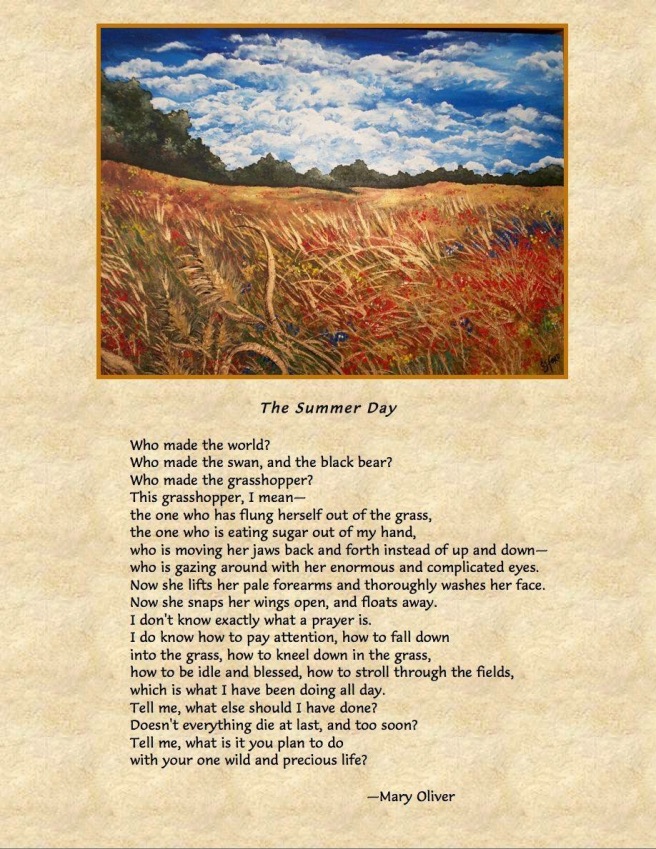
Maybe my longing is to be fully present to summer in ways I haven’t been this year because I have been caught up in the “doing” part of summer instead of the “being” part.  Maybe what I need to remember is, “how to be idle and blessed…”  After all, we only have one “wild and precious life.”

IMG_2897 2.JPG


Pot Luck Star

I have been a bit of a pot luck star this summer and I’m going to make you one too. Our summer gatherings here in the country tend to be pot lucks. It is an easy, affordable way for people to gather for a meal on a warm summer evening. Except for this year, I have been much more likely to bring something savoury to share rather than something sweet. That all changed when I intercepted this recipe being shared online by Canadian cook, Laura Calder, who self confessed that she couldn’t stop making them. Of course, that piqued my interest and the total simplicity of the recipe settled it for me. Since making these cookies, I have noticed that there are a number of different variations online. Some of them use salt, vanilla extract and cream of tartar,  but I find this recipe is just fine as is. I like adding the unsweetened sifted cocoa because it does seem to cut the sweetness a bit. Enjoy!

IMG_2887 Chocolate Chip Meringues (photo credit kd7167)


Chocolate Chip Meringues

Ingredients:

3 egg whites

1 cup of sugar

2 T sifted cocoa

170 g dark chocolate chips

Optional: small handful or scant 1/4 cup of roasted sliced almonds

Directions:

Whip 3 egg whites while beating in a cup of sugar a spoonful at a time. The mixture should become thick and glossy. (This usually takes about 8 minutes.) The mixture shouldn’t taste granular at this point. Fold in the sifted cocoa, the chocolate chips and the nuts if you choose to do so. Drop by spoonfuls onto parchment lined cookie sheets.

Bake at 275 for 35 minutes. 


Ticks, Lyme, and Long Walks

IMG_1040

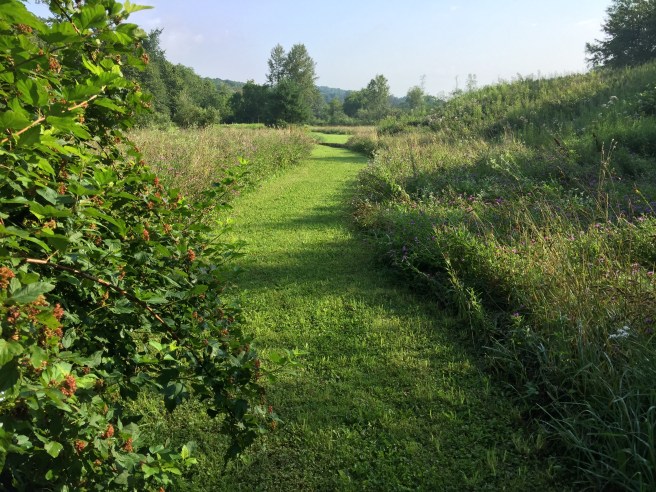
Here in the country the woods are our backyards and tall grass abounds. We have a woodland path that connects our house to our neighbours,  a ten minute walk away. When the children were little we used this path many, many times a day. Summers are steamy here, so we wore shorts and t-shirts and had flip flops on our feet. Forward twenty years and nothing still brings quite as much pleasure as escaping the heat of the day in the canopy of the forest.

When I walk in the other direction to our rural mailbox, I often cut through our field on the way home, thinking little of the detour and often stopping to see what’s growing or living in the tall grasses.

IMG_2879

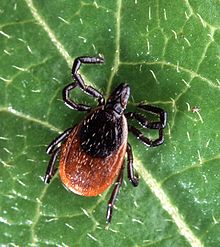
The days of carefreeness on these walks has changed now. It is sad to think that walking in the woods or taking a shortcut through the field brings hazards these days when it was done without a thought just a few short years ago. We have always had ticks in this area and I would frequently find them on our animals, but Lyme disease which was not identified until 1977 lingered to the south of us. Lyme was never an issue here until climate change meant winters have become milder and the bacteria (Borrelia burgdorferi) has been able to survive these warmer temperatures. It is now in our area just north of the Vermont border.

IMG_2877 2

What does this mean for us and our closeness to the natural world? Experts say we should dress head to toe in long clothing, tuck our pants into our socks and douse ourselves with Deet before venturing into the woods. This makes sense if the goal is to make sure that nary a tick lands on you. But what of short forays on steaming hot days when dressing in this way would just deter you from going at all? And that’s my fear. Not the ticks as much as the thought of losing a carefree lifestyle we treasure. We moved here so that we could play in the woods and fields.

My husband and I have both found ticks on our bodies in the last few years and so have our neighbours. My husband didn’t discover his until it had been on for a few days and he had developed the classic bull’s eye rash. This meant a visit to the doctor and a round of antibiotics. My tick I discovered while showering after working in the garden. It had only been there a short time and I removed it carefully with tweezers making sure to not squeeze its body. Since it had only been attached for a few hours, I only had to watch for any symptoms that might emerge in the next 3 to 30 days. I wish I could say that I am relaxed about having ticks in this area, but I’m not.

I think twice about spontaneously going into the woods these days or cutting through the field. I make sure when I am in the woods to wear long pants and a hat. I often shower when I get back and check myself very carefully, not ignoring strange places like between my toes and behind my ears. I probe my scalp and hair feeling for any raised bumps. It’s a drag. And it has changed our lives. But it is not stopping any of us from enjoying the woods. It is why we moved here. We are still roaming our properties, albeit more cautiously than a few short years ago.

Transitions and Mushrooms


I have started this post a few times now as I try and bring myself (and you) up to date. I have been mostly transitioning back to our country property after our trip to London. That has meant doing all of the immediate things that have required doing – staking a few plants, getting food in, and taking stock of the changes that occurred while we were away. It has been raining almost non stop here these last three weeks. There has been so much rain that there was a small landslide on the cliff on the other side of the brook which has altered the course of the stream and created a new little waterfall. As I was surveying this on the weekend, I noticed lots of mushrooms growing along the banks and that is where my curiosity is leading me this morning.

IMG_2867 2

I have studied wild flowering plants that grow in this area for years but never paid much attention to the mushrooms and fungi that grow here except to stop and admire a particularly large or unusual one that I would happen upon on my walks. That has all changed since we bought our neighbouring 15 acres of woodland next door. As I get to know this land, I have decided to learn about the mushrooms and fungi growing there as well.

I was only able to take a short walk this morning, kind of a scouting mission if you will. But I did come across this:

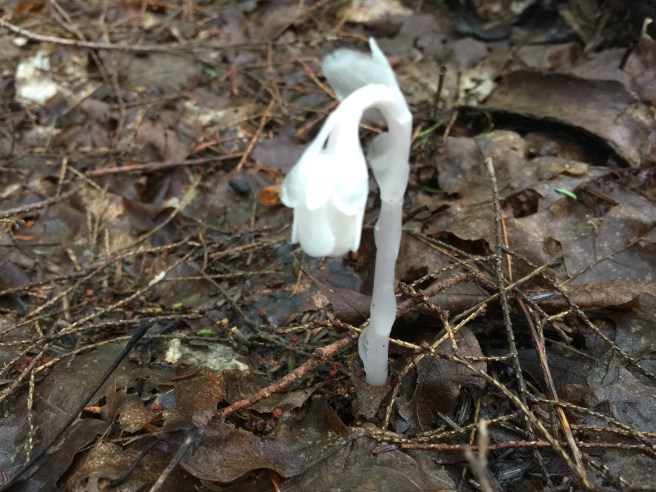
IMG_2868.JPGmonitropa uniflora (ghost plant, Indian pipe, Ghost pipes, corpse plant)

This is not the first time I have seen this ethereal plant in a woods. It is quite striking as you can see. It is considered scarce or rare in appearance but I discovered a healthy colony of them growing not far from the house.

I have a number of mushroom identification books to help me in this new study  and I brought my first two mushrooms home to identify.  Many many more, I left in the woods for another day.


We’re Off to London…and You’re Coming Too!

IMG_2721 2

We’re off to London and you’re coming too! In a few days we will be in Richmond (south-west of London) visiting my daughter and her family. I am beyond excited to see my three grandsons, two of whom we haven’t seen since they were born in September. Yup, twins and a three year old. Almost guarantees that there will be a child in my arms during most of the waking hours.

My suitcase is open on the floor and the first clean clothes have started to be added. That’s a good sign.

IMG_2733.JPG

I seem to go through a number of predictable phases whenever a trip is in the offing and I thought I would share them with you.

  1. Excitement: The trip is booked and there is no turning back. Almost time to unleash the moorings and let the wind catch the sails.
  2. Wardrobe Crisis: I know the trip is real when this very predictable phase begins. Living here in the country, my wardrobe in the summer consists mostly of old t-shirts, stained pants, and slip on shoes that I can wear in the gardens. Not exactly big city worthy! Time to replenish and uplift my wardrobe. For the summer, this means finding a couple of dresses and skirts that are the right measure of casual, updating the t-shirts and making sure I have good walking shoes and sandals that I can pair with it all. This wardrobe update takes most of my free time in the month or so preceding a trip because it usually involves longish drives to shopping sources close to the city.
  3. Gifts bought: For this trip that means toys and clothes for the grandchildren. The three year old has already told his mother we always bring him lots of toys in our suitcase. No pressure!
  4. Overwhelm: This is the hardest phase and has me wanting to stay in bed with a pillow pulled over my head. For some reason, I feel I have to put my whole life in order before undertaking any trip. And in the country, on a large property, nothing is all that orderly in the summer. In addition, it means making sure my 96 year old mother has all the support and books and money she needs to tide her over while I am away. Throw in a birthday party and a few social events and you have the set-up for number five which follows.
  5. Frazzled nerves and exhaustion: This is when I go a little crazy and nobody really wants to be around me.  I don’t even want to be around me.
  6. Excitement: This last phase which also happens to be the same as the first only happens after the two hour drive to the airport, drop off of the car and the bags have been checked. It always entails a glass of wine or two.

IMG_2722

I promise you though, when we get there it’s going to be fun.

IMG_2723Whee!!

Can’t wait to show you around.


Happy Solstice Everyone!

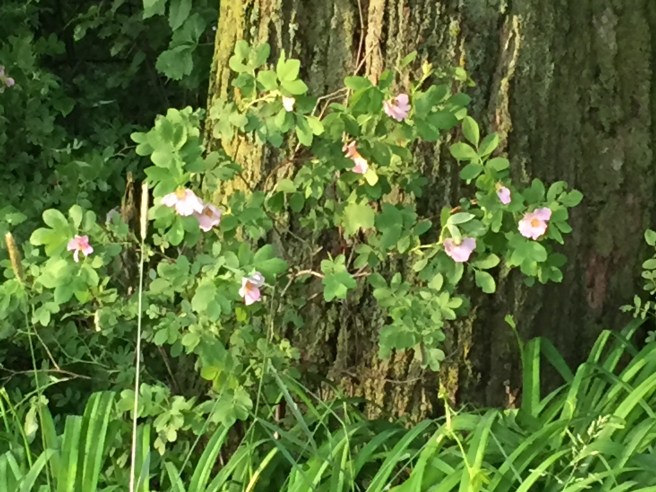
IMG_2712.JPGWild roses in the pre-solstice evening glow.

Here in the country we are very aware of celestial happenings. Most of us can identify the different moon phases and know the kind of light they shed on the nighttime landscape. Full moons, for instance, mean that events usually held in the day can be held at night. In  the summer months there are full moon kayak excursions on the river and hikes on the mountain trails. In winter, it is snowshoeing or cross country skiing by the light of the moon. By contrast, on the dark of the new moon we know to bring a flashlight on any nighttime meanderings. And so it goes each month and through all the seasons marking the passage of time by the phase of the moon or the position of the sun in the sky.

One of the two biggest solar events of the year happens today. Summer and winter solstices are both very different but both really significant and worthy of  celebration. The summer solstice happened at 12:24 am EDT this morning and marks the day with the longest sunlight hours of the year. The word solstice itself is derived from the Latin sol (sun) and sistere (to stand still) because at the solstice the seasonal movement of the Sun’s path (as seen from Earth) momentarily comes to a stop before reversing direction. The pessimist in us might lament that it is all downhill from here. (I must admit this thought always surfaces for me at some point on this longest day.) However, the present moment beckons and with it the giddiness of this day filled with light.

I will be at a beautiful country setting overlooking fields and a lake this solstice evening eating outside with friends. I will probably return home before day turns into night but what better way to mark the longest day of the year than outside with friends.

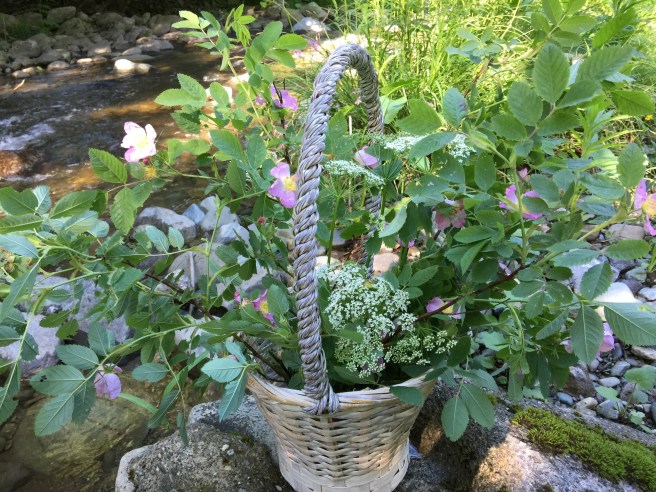
Every solstice since I have lived on this country property I have gone outside and picked  the flowers that are blooming at just this time. My only criteria is that they have to be wild and beautiful. I always pick the pink roses that bloom on our property and along the road. I combine them with the feathery foliage of  an annoying weed like plant which is as robust and strong as the sun.

IMG_2713.JPG

My bouquet this year is not really up to snuff: the torrential downpours and gale force winds yesterday got to the roses before I did. But it’s the thought that counts. Right?

Happy Solstice Everyone!

Rhubarb Reborn – A Recipe of Sorts


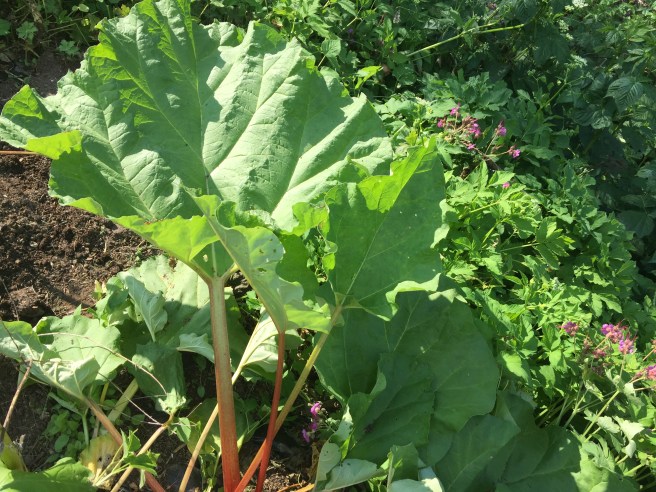
IMG_2658.JPGRhubarb (Rheum rhabarbarum)

Do you have a recipe or cooking technique that you discovered a long time ago and still use today? This is one of those for me: both a recipe and a technique that I haven’t seen improved upon since I discovered it way back in 1978.

Rhubarb is one of the first food plants to be harvested from gardens in these parts. It is not a true fruit but is prepared in kitchens as if it were. Rhubarb has been perfected as an ingredient in pies, cakes, crisps and cobblers (often in combination with strawberries) but the simplest preparation, commonly known as stewed rhubarb, has not traditionally been a very appetizing way to eat this fruit. It is often stringy and cooked into a sloppy mush that lacks the beauty and integrity of the real fruit with its firm red and green stalks.

Way back in June of 1978 from a publication at the time called Organic Farming and Gardening, I ran across this recipe called Rhubarb Reborn. (I wish I could give credit here to the person who contributed the article but I only have one very yellowed and food stained page.)  All I can say is that this recipe gave me a whole new rhubarb eating experience. Simple is often the best.  Trust me, this recipe will be in your repertoire for a long time.
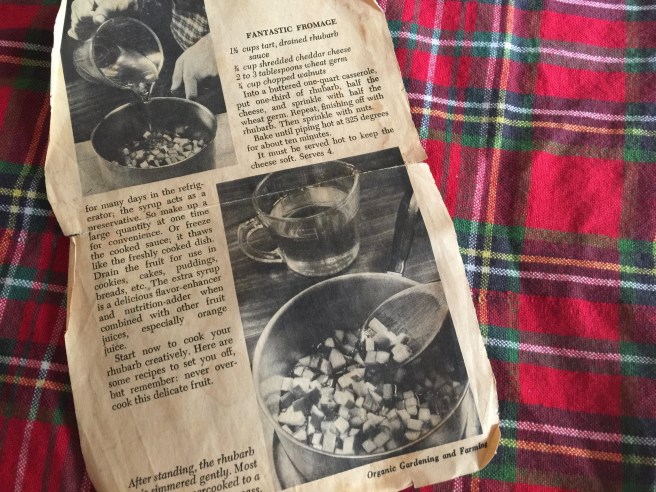
fullsizeoutput_204

Rhubarb Reborn – The Recipe

To make Rhubarb Reborn you will need about a pound of rhubarb stalks, so think about 4 cups of diced fruit. The recipe is easily adaptable as you’ll see so use whatever you have on hand. Don’t peel any of the stalks as the beautiful red adds colour to the prepared fruit. All the stalks need to be split lengthwise, even the very small ones. The large ones can be split four or six times. Each split section should be about 1/2 an inch wide. (This seems to prevent any stringiness.) Stack a bundle of the split stalks and slice about 1/4 inch wide. Now you are ready to measure your diced fruit and add honey. The proportion of sweetener to diced fruit is a matter of taste. For a tart sauce, use 2/3 cup of honey to four cups of diced fruit. For a sweeter, richer sauce use 2/3 cup of honey to two cups of diced fruit. I find the more tart version plenty sweet enough for my taste. The prepared fruit needs to soak  for at least an hour so all the cut surfaces can soak in the honey – a couple of hours is even better or overnight is ideal. You’ll notice that the juices from all those cut surfaces combines with the honey.

IMG_2641.JPG

This part of the recipe is really important. Quickly bring the diced fruit to a simmer  and let it simmer for barely a minute.

IMG_2643.JPG

Remove it from the heat and put on a lid. The fruit continues to soften in the hot syrup. Don’t overcook it. Et Voilà, finished! If you wish you could add some cinnamon or ground ginger for a little extra flavouring, but I like mine just like this.
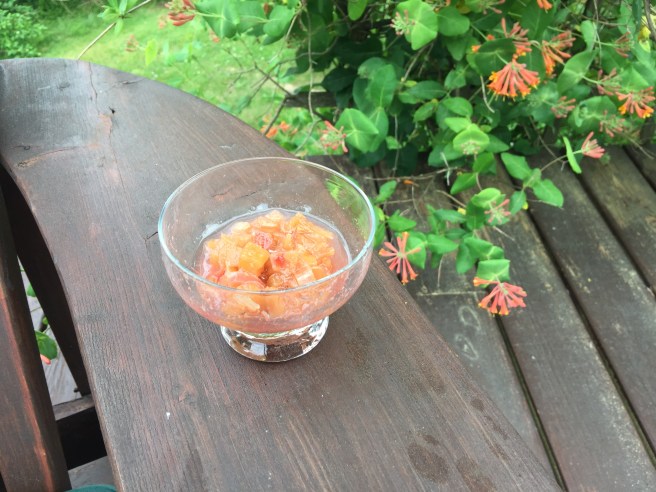
IMG_2670.JPG The colour of the prepared rhubarb mimics the climbing honeysuckle in this picture.

This preparation freezes really well and looks and tastes the same unthawed as when originally prepared. It is delicious alone but can be added to yogourt or granola for a seasonal breakfast or eaten with ice-cream for a sweeter dessert later in the day. Add a tablespoon or so of the sweetened sauce  to a glass of sparkling water for a refreshing summer drink on the patio.

 IMG_2666.JPGThe sauce gives the sparkling water a beautiful pink hue.

Rhubarb Reborn can also be made unsweetened and used in meat sauces or other dishes. For this preparation cut it the same way but instead of honey simmer it in a few tablespoons of orange juice.

Do you have a favourite way of preparing rhubarb? I would love to hear about it.

A Wee Garden Tour

IMG_2575.JPGThe early morning sun shines on the vegetable garden.

We have a small vegetable garden close to the house that I often refer to as a kitchen garden. There are a number of great reasons to have a garden close to the house: ease of picking is one and the second being that we don’t need a fence to keep the deer from having a feast every night. The tall onion-like plants you see growing are the garlic that we planted last fall. They will be harvested when they start to yellow at the end of July. The tunnel is covering kale and broccoli plants.  They are hardy and don’t need the covering for warmth, but we are trying to keep the flea beetles from devastating them. Whatever we can’t grow in this garden we buy from organic growers in the area.

This garden is small by our standards because in the 1980’s we grew a few acres of vegetables in the sunlit field you see in the background of this photo. But that is a story for another time.

IMG_2612And, yes, we have flowers. Lots and lots of flowers.

Our  flower gardens grew and expanded as we landscaped and tweaked the front of the house. We now have perennial flower gardens bordering the walkway leading to the house and beyond to a cliffside deck.

IMG_2623.JPG

All of the shade loving plants had to go somewhere so we created another border on the shadier side of the lawn. The hostas loved the cold, rainy spring we had this year.

IMG_1018

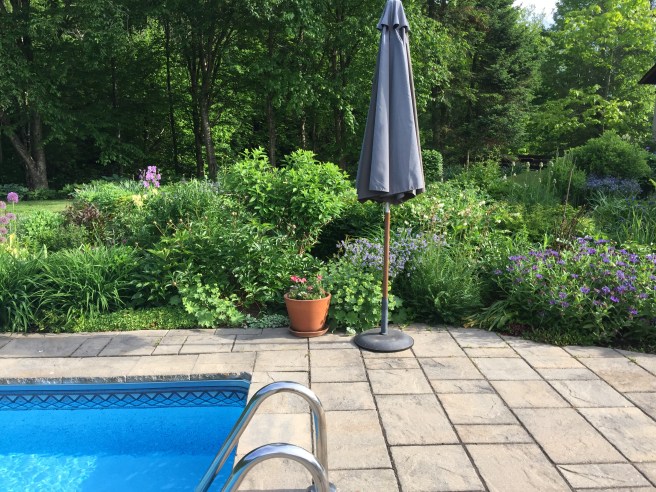
We also have a pool so adding more flowers there just seemed a natural landscaping solution at the time.  Add to that pots and planters and the walled garden by the driveway and you have a whole summer’s worth of beauty…and work!

IMG_2627.JPG

Most days in the garden start and end at the brook: perfect for washing off muddy hands and feet. And for giving thanks.

IMG_2649.JPG


The Wheel is Turning, Summer Approaches


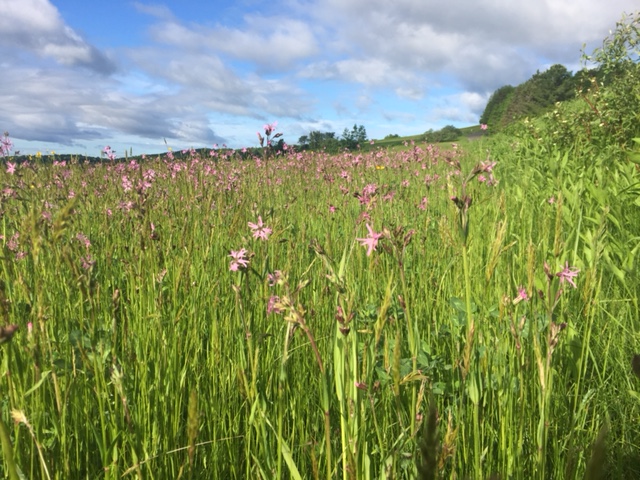
IMG_1009.JPGRagged-Robin (Lychnis flos-cuculi)

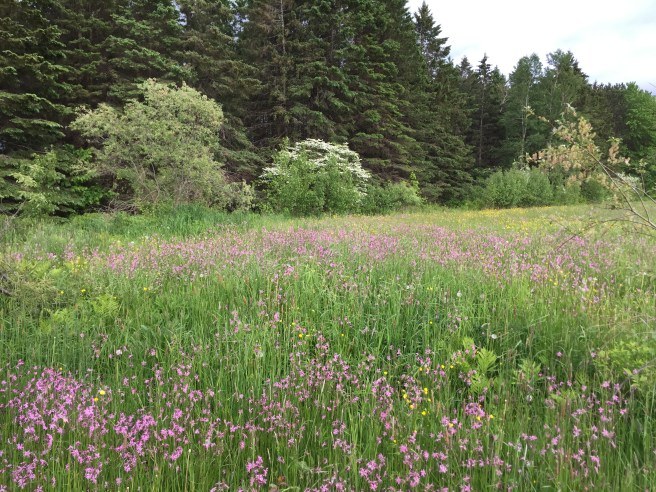
I mark the passing of the seasons by the wildflowers blooming along our roadside and the appearance of the first Ragged-Robin is always bittersweet for me.  Ragged-Robin blooms here at the start of haying season which means the euphoria of spring and the first burst of growth  is over and our thoughts have moved to stockpiling food for the less kind months.

IMG_1015.JPG

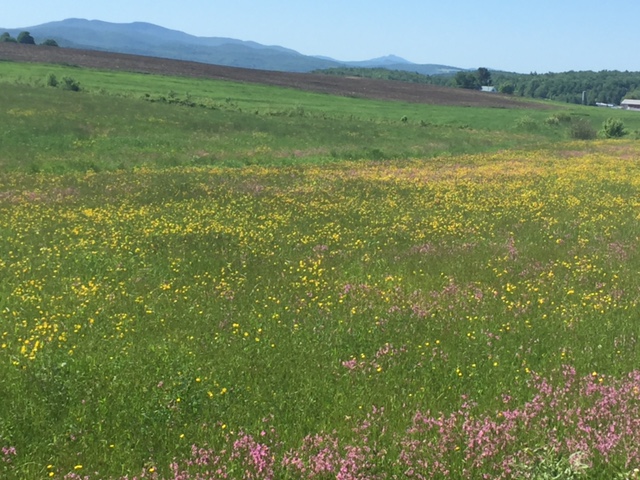
When we moved here thirty-four years ago Ragged-Robin began appearing in the ditches towards the end of June which coincided with haying season at the time. But the fields are being mowed earlier and earlier now, sometimes starting as early as the beginning of June. So much for climate change deniers!

Ragged-Robin is a native to Europe and is found along roads and wet meadows there. It has become naturalized here in eastern Canada and certainly shows the potential for being quite invasive. I first noticed it growing in the ditches, but since then it has moved into all of the pastures and blooms alongside the buttercups, another invasive plant.

There is a lot of plant growth still to happen and a new season to greet, but spring with all of its promise is passing. The wheel is turning, summer approaches. At least Ragged-Robin announces the approach of the new season with flare.

IMG_1022

Oodles of Noodles – Zucchini That Is

I wrote a few blog posts back about my health plan for the spring which included checking out the diet called the Whole30. It is a thirty day eating plan that eliminates the common inflammatory causing foods: dairy, legumes, grains and sugar. The idea is that you slowly begin reintroducing these foods at the end of the month, monitoring your body’s reactions, if any.

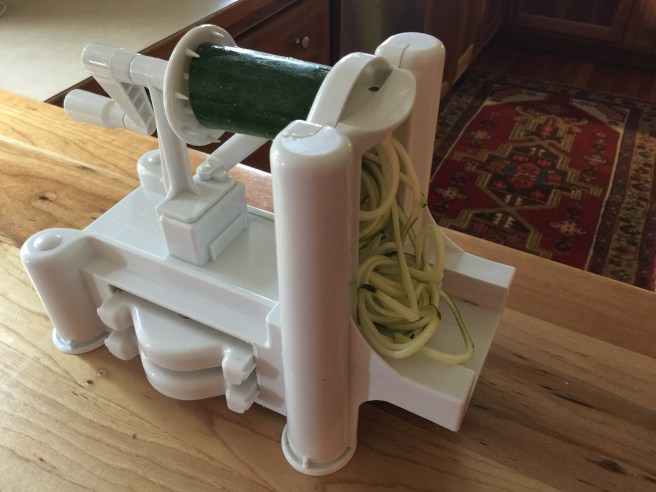
One of the decisions I made early on was that if I was going to eliminate many of the foods that give variety to my diet, I had to find alternatives that add texture and flavour to my meals. My husband and I love to eat pasta. It is one of my quick, always delicious, meals and we eat it about once a week in the winter. Pasta is certainly out in this diet, but I thought of ways to continue having this texture in my foods. Spaghetti squash is an alternative, but I have never enjoyed this vegetable. I find it time consuming to prepare and the results never warranting the effort. That’s where my new spiralizer comes in. I got the idea from a friend visiting in the winter who mentioned they have been spiralizing their zucchini as a pasta alternative. I remember thinking at the time that zucchini was a pretty lame excuse for pasta, but desperate times call for desperate measures. A short three months after this conversation, I found myself buying a spiralizer.

IMG_2584.JPG

The spiralizer I bought is a very simple plastic machine with three different cutting blade attachments. The machine made very quick work of the zucchini and before long I had a mound of spaghetti-like strands ready for dinner.

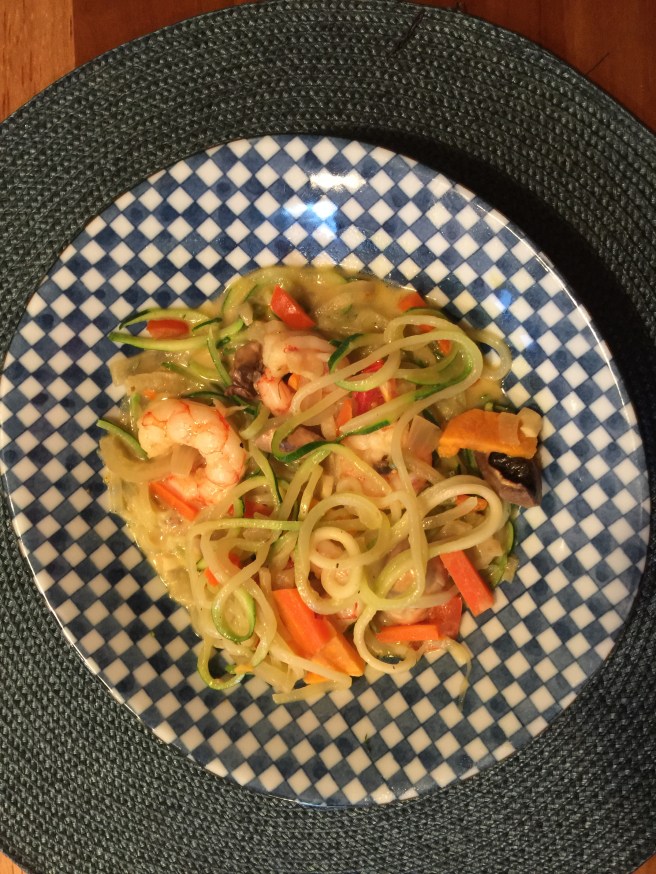
One of my go to pasta recipes in the winter is a no fuss shrimp curry. I decided to make it with coconut milk this time and added onions, garlic, fennel, peppers, carrots, sweet potato and a jalapeño for heat. While the curry was simmering away, I gave the zucchini pasta a quick sauté in olive oil until  almost translucent. It went at the bottom of the bowl with the curry on top. Delicious.

IMG_2589Shrimp Curry with Zucchini Pasta

The zucchini experiment was so successful I decided to move on to carrots.

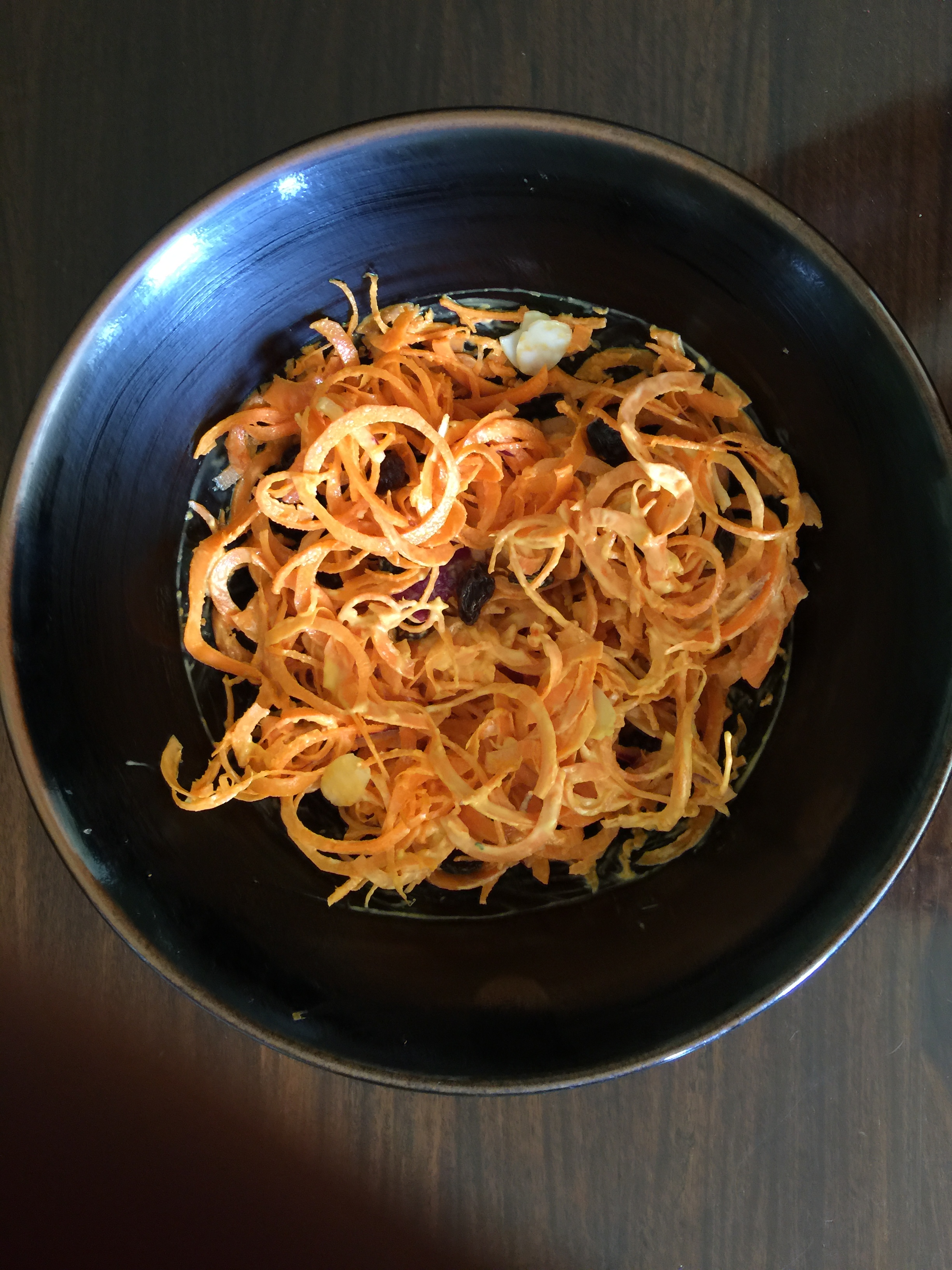
IMG_2570.JPGCarrot Salad with Curry Mayo, Raisins and Sliced Almonds

Disclosure: The carrots had been in winter storage way too long and were old and tough. Spiralizing them took some effort compared to the zucchini. I will definitely try carrots again but this time will use fresh.

I am quite excited now about the possibilities potatoes hold with this new machine. I’m thinking rösti potatoes, potato chips baked in the oven, and spiral crisps.

In conclusion, I think this is a kitchen tool that I will use even after I finish my month on this eating plan. It has very simple parts and is easy to clean. We’ll see.