There’s a Ghost In the House

You know how some of the most startling information comes to us in the most nondescript of ways. That is exactly how I heard about the ghost in the house.

I was finishing up from a long and tiring day at school, slumped at my desk trying to make some order of the papers I had flung there. The custodian was also doing his part to bring some order to the chaos and was sweeping the floor beside me. He asked if we had met Mr. Harland yet. “Mr. Who?” He had my attention now despite the pull of wrapping up early and heading home.

“Mr. Harland,” he replied in the same casual way.

“Who is Mr. Harland?” I pressed.

“Well, if you haven’t seen him yet, you surely will. He’s around.” And with that cryptic statement he moved out into the hallway to talk to someone wanting his expertise on this or that.

I don’t know if it was just because I was tired at the end of the day or because in my family I had learned to gather important information in little morsels thrown my way just as this had been, but I didn’t run after him. That doesn’t mean that this new information wasn’t put at the very top of my: When I Have a Minute List.

You see my daughter had just bought a home on one of the winding mountain roads not far from where I live. The two storey house had a new addition full of windows and light but the original part of the house where the kitchen and dining room were located had been a log house dating to the 1800’s. This log home and the surrounding terrain happened to be the ancestral home of my friend, the custodian.

I had gathered from our brief, cryptic exchange that he was telling me about something otherworldly. I have always been curious about ghosts and have heard stories from more than one person about their encounters with them, but up until now none of these presences had a personal connection.

I had a lot to process that night. I have a very vivid imagination that can easily slip into the macabre without a ghost presence pushing it in that direction. I thought about my daughter being alone in her home and wondered if I should let her know this latest piece of information. Maybe I could talk about the plumbing and the new lighting and slip in, “Oh, by the way, there’s a ghost.”

After a restless night spent tossing and turning, I decided I needed more information. At school the next day, I broached the subject once again. “I am wondering,” I began, “about Mr. Harland.” There was a long, deliberate silence. I decided I would just come out with it. “Was Mr. Harland an axe murderer?” Another long pause ensued.

“No, Mr. Harland was a very good man, a kind man,” was the answer. It seems he had decided at one point and for his very personal reasons that he had had enough and committed suicide. With this newest information, my perceptions about this particular ghost made a radical shift.

Whenever I spent time at the house after that I was always very conscious of Mr. Harland’s’s story. My daughter, who was living overseas, never actually slept in the house while she owned it, but she did have a whole series of renters none of whom ever shared any stories of encounters with Mr. Harland. My son, who knew the story and spent a few weekends there with friends, said that the only thing he noticed was that when the group gathered for a meal they all felt as if someone was missing, only to see that they were all there.

I have always been curious about ghosts. I find it interesting that everyone I have talked to over the years about “ghosts in the house” speak of these presences with a warm affection. Talking about ghosts seems to be a bit of a taboo subject for some, but for others it just seems to  be a fact of life.

For my part, I am deciding to pursue my curiosity and gather more stories. Homes come with all kinds of stories, it seems.

Beginnings and Endings

IMG_2349.JPG

I have been thinking about beginnings today. It is the first really warm and sunny start to a spring day we have had this year and the garden is full of daffodils, scilla, and hyacinths in full bloom. I have just cracked open a brand new moleskin journal with all the potential that holds and we are at the new moon phase of the month. All beginnings, and all holding the joy of the unknown that is about to unfold.

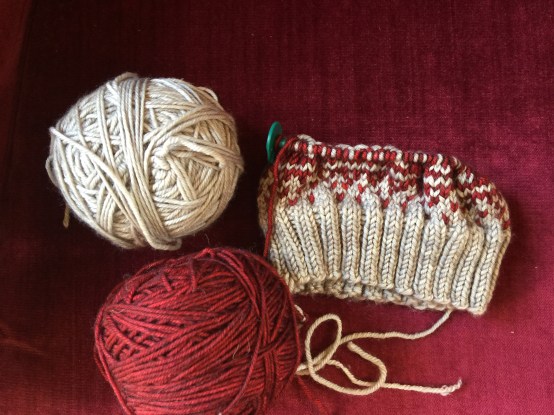
Along with beginnings, of course, also come endings and I have been thinking about those also.  I am thinking today of some of the endings that I have not done well. I have this beautiful sweater sitting in my basket with only a small part of a sleeve and a button band to finish.

IMG_2352.JPG

It has been there for a year, maybe two. And this hat…

IMG_2351

Both projects will require some concentration and relearning on my part because they have been put away for so long. But as I look at them now I can see the beauty in them that attracted me in the first place. Maybe I don’t finish things when they get hard because it is easier to move on to the next exciting project than to stay with the much more difficult task of bringing something to completion.

It is not only my knitting project basket that holds the discomfort of the unfinished. I have two university certificates each lacking the final course because when it came time to complete them my life had moved in a different direction. I am not good at dividing myself. It is a quality of mine and also a fault as all my unfinished projects so vividly remind me.

I am getting better at completions. I have had to. I am learning that as hard as they are, they are the necessary final act: the tying together of all that has come before. My greatest teacher about this was my father. I am thinking about him this morning because it was on a day something like this six years ago that he was diagnosed with a brain tumour. He died within three months. I had had my own first really serious health issue shortly before but I knew I had to be there for my dad’s final act. This was not something I could leave in a project basket to pick up again later. There were no final chances here. I showed up for him every day even though it was gut wrenchingly hard and my tears flowed freely. It taught me about resilience and love and doing the right thing even though it took every bit of emotional stamina I had. And it taught me that endings can be even more beautiful than beginnings if they are done with presence and love.

And for this final lesson, I am forever grateful.

Five Stages of Creativity

There was an internet meme being passed around a few years ago that struck me as truth. It described the five stages of creativity this way:

This is awesome.
This is tricky.
This is terrible.
I am terrible.
This is awesome.

Nothing I had seen to date had captured my creative process so accurately.

This Is Awesome

I am a lover of the blank page, a still rolled skein of wool, an untouched canvas on an easel, a bare patch of soil waiting to become a garden. They are all so ripe with possibility that my heart skips a beat just thinking of all the beauty lying dormant waiting to explode out into the world. There is nothing quite so saturated with colour and possibility as the imagination. Imagination lies in the realm of the gods. That is, until we try and pluck it from the ethers and bring it down to earth.

Ann Patchett, the American novelist, describes this phenomenon in her short story The Getaway Car . She likens her imagination to a butterfly with wings of indescribable beauty as if cut from the panes of the rose window in Notre Dame. It is glorious and free and holds all the possibility of the world. Then she begins to write and it is here that the butterfly gets killed.
It’s not that she means to kill it, it’s just what happens when something as beautiful and three dimensional as the imagination gets flattened into two dimensional form with words.

It’s an act of great bravery to put the first stroke of paint on the canvas or to type those first tentative words on the blank page. Most people never get to this point. That is how much courage it takes. Giving myself permission to play and not worry about the finished product has been the key for me. I have never completed a project that doesn’t have some mistake woven into it. Many times the final work feels as if it only tells part of the story and is unfinished somehow. I am okay with that now. Paul Gardner says it this way, “ A painting is never finished – it simply stops in interesting places.” The mistake, the imperfection, is what gives my knitting character, my words a voice , my gardens my personal imprint.

This Is Tricky

I am drawn to create and work with my hands but nothing quite prepared me for the extreme discomfort I inevitably feel at some point in every project I undertake. The initial excitement (bordering on euphoria) of beginning a project moves quite quickly into the “this is tricky” phase for me. I remember painting for the first time and realizing that the paint was not behaving in the ways I was expecting. It was thick and began drying before I could get it on the canvas. The luxurious, cashmere wool I bought also held so many possibilities for me. I had never felt anything so soft and buttery and just thinking about it next to my skin sent me into paroxysms of joy. Only to discover that the fineness of the thread and the lacy pattern I had chosen made knitting with it very, very tricky and fixing mistakes almost impossible. Writing is also fraught for me. Finding the right words to describe a feeling, a knowing, can be extremely tricky. And say nothing about gardening. Trying to keep unruly plants in harmonious colour schemes or in waves of colour is very, very tricky.

To get past this hurdle, I allow myself to produce a “shitty first draft,” as Anne Lamott calls it. This doesn’t mean that at some point in the process, I don’t gather the section of words that feels authentic and truthful or don’t go back and repair a gaping hole in my knitting. It just means that I am willing to start and take my process where it wants to go. There is always another story to write, another scarf to knit, another garden to plant and these too will be filled with the same sense of wonder and possibility when they are in the imaginative phase. And each one will also be very, very tricky.

This Is Terrible

Coming on the heels of “This Is Tricky” is the “This Is Terrible” phase. It is at exactly this point the project will either move ahead to completion or be turfed. I remember looking at my scarf as a young girl of eight and realizing that what I was knitting was not beautiful at all. It had holes that I was inadequate to fix on my own and I had dropped stitches along the way so it had been getting narrower and narrower as it grew in length. All this as I was listening to my mother’s needles clicking away rolling out what seemed to be reams of flawless knitting.

Feeling that something that started out with such glorious possibilities has turned into something terrible is very hard to stomach. It is looking at the glorious butterfly of Ann Patchett’s imagination and seeing its “broken body chipped, dismantled, and poorly reassembled. Dead.” It is a wonder that any books get written or any artworks shown given this train wreck phase of the creative process. But this is exactly the time to keep on going, at least in most instances, and the only way to do that is to breathe, put it aside for a few days if one must, and then slog on being totally uncomfortable but also willing to bring this imperfect mess to completion.

I Am Terrible

And speaking of imperfect messes. How about our own role in this fiasco? It is here that it all gets very, very personal. It is not that great of a leap to go from this is terrible to I am terrible. We are, after all, the creators of this mess and we don’t have to go very far to start assigning blame. And every single worthiness issue we have ever faced in our life gets triggered when blame is assigned and the recipient is ourselves. Shame, of course, is a huge suffering place. The only way to get to the final step in the creative process is to wade through this swamp.
And how to do this? Continue on allowing the imperfections to surface, correcting those that can be corrected and accepting the rest as part of the practice that is required to become an expert at anything. It helps to speak to others engaged in creative endeavours because every single one of them is familiar with this place. And they don’t let it stop them.

This Is Awesome

For me, the “This Is Awesome” phase doesn’t begin with such a strong pronouncement. It is more like, “This Is…..,” followed by a long pause. I need to give myself some distance from what I have created before I can look at it with any kind of objectivity. (I have learned this is probably not the best moment to share my creation with others.) I vacillate between being super excited that I was able to create something given what I had to go through and wondering if there is anything at all redeeming about it. With a little distance, and looking at it in different lights, I begin to see ripples of beauty here, the truth of words spoken in honesty there. Somehow, that is enough to infuse the whole thing with “awesomeness.” And this belief in its awesomeness paves the way for the next great idea to land.

Clay…and me


I tend to process things more deeply (some might say intensely) than many people, so it is no surprise that some of my favourite stories are of transformation. And some of my favourite stories of transformation revolve around clay.

2015-02-16 11.37.18.jpg

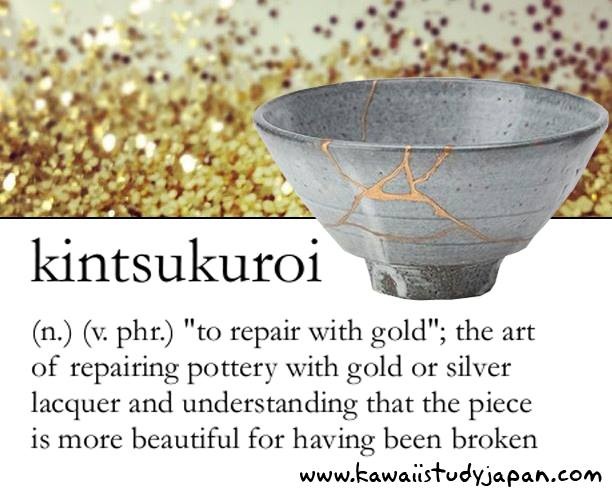
Seeing this image of the Japanese art of Kintsukuroi for the first time struck a deep chord. Who would have thought that breakages and cracks and imperfections could make the original vessel even more beautiful? I am a recovering perfectionist: I have an eye for imperfections. I can spot a crack or a stain or a grammar mistake where most people see none. And they bother me until they are fixed or removed. The thing is, stains rarely disappear entirely and there is always another grammar mistake looming, another crack waiting to appear. To work with them in such a beautiful way seems like a much better plan to me.

The fable of Kintsukuroi can be read here: https://philipchircop.wordpress.com/2013/11/10/the-fable-of-kintsukuroi/

My other favourite clay story is that of the golden buddha. In Thailand in the 1950’s a monastery was being relocated to make way for a highway that was being constructed. There are some differences in the stories that are told about what was to unfold but it goes more or less like this. The monks were moving a clay statue of the buddha to their new monastery. It was so heavy that they had to use a crane to lift the statue and in the process a crack appeared so they gently lowered it back to the ground. It began to rain so they covered the statue with tarps. During the night a monk went out with a flashlight to check on the statue. As he was verifying that the tarps were all in place his flashlight caught a glimmer of light inside the crack that had appeared. Upon further investigation and subsequent chipping away at the clay the treasure inside was slowly revealed – an almost ten foot tall solid gold buddha had been resting inside. It is believed that years before the monks of the monastery, fearing an attack from Burmese marauders, had covered the valuable statue with clay so that it would be seen as worthless by the invaders. The monks were all killed during the attack and so their secret and the golden buddha had remained undisturbed until the time of the move.

Both stories are such powerful metaphors of the human experience. The Japanese understand that chips and cracks make vessels unique and beautiful. And the Thai’s knew that clay was a needed protective covering in desperate times.
My own transformation story involves clay as well. My formative years were lived on Clayes Avenue. The house I live in now and where we raised our children is on Claybank Road. And my newest grandson Klay just joined our family. The coincidence of this seems auspicious to me. And golden.

On Long Walks

I’ll tell you what I have learned myself. For me, a long five or six mile walk helps. And one must go alone and every day.

Brenda Ueland

It is a five kilometre walk down our country road to the place where the gravel meets the paved highway that connects our town and the towns north of here to Vermont.

My walk takes me down a less traveled dirt road and passes our field which used to grow three acres of organic vegetables but now is cut for bedding for the neighbour’s cows. It continues up the first slope with views of the stone manor house at the top of a long, winding driveway on the left.

IMG_1314


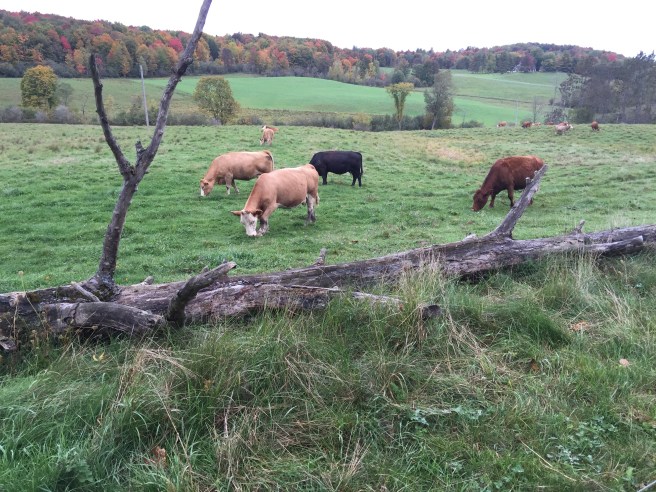
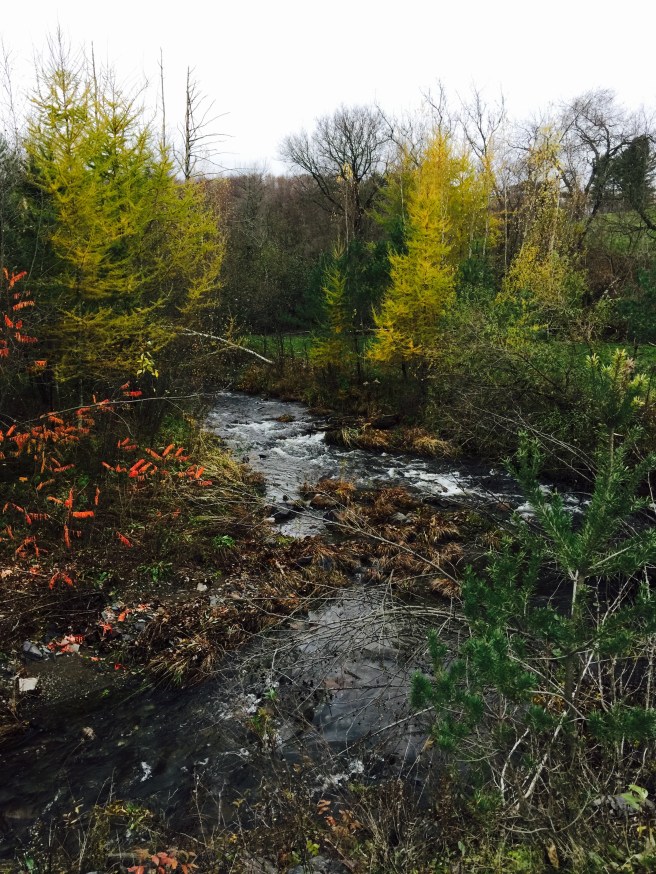
The stream that runs behind our house crosses the road here and I often stop on the bridge to watch its progress to the larger river which it joins not too far from this spot. It is usually quite a mild mannered stream but it can rage during heavy, sustained rains or when the snow cover at its source on nearby Pinnacle Mountain is heavy and spring erupts overnight instead of blossoming slowly. There is a barn at this junction and the cows are often grazing in one of the fields near the road.
I often stop to talk to them or take a picture or just soak in their relaxed presence.

unspecified

Cows are masters of mindfulness. The sun on their backs, the grass below, and the next mouthful of grass is their meditation.

The road from here hugs the Sutton River that has its source on the largest mountain in our area and joins the more majestic Missisquoi just across the border. It is along this stretch of the road that I can sometimes catch a glimpse of a family of mallards or once even an otter playing on the ice floes during the spring melt.

IMG_1621
If I am going to be joined by any human company, it is at this point where I might meet a man from town out walking his dog. And so goes my walk most days.

A friend of mine who used to live close to here but has now chosen the city as her favourite place can’t really understand my fascination with walks in the country because there is no destination. That is precisely the pull for me.

I walk through all kinds of emotional landscapes. My angry walk is heavy and staccato like – each step an exclamation point. On fearful walks, I am alert to everything around me, fine tuned to all sounds and possible dangers. Sad walks are slow and watery as if I am willing the sky to descend and share the sadness with me. The road is my 3D journal. It holds the energy of my life and documents all its passages.

There is something that happens on these walks. With each footstep I come closer to something elusive that seems just out of reach. Sometimes an idea arrives on a wind current, sometimes it’s a knowing of the next right thing to do and sometimes it’s words that were stuck that spill out and have me scrambling to catch them before they disappear again.

And sometimes on my walks nothing much seems to happen at all.

But when I am outside taking one step after another I am able to live for a moment the Rainer Maria Rilke poem.

I live my life in growing orbits
which move out over the things of the world

And the truth of these lines descends…

I am circling around God, around the ancient tower,
and I have been circling for a thousand years,
and I still don’t know if I am a falcon, or a storm,
or a great song.