Conkers, Brights, Shiners, Cheggies, Obblyonkers,Cheeses


fullsizeoutput_27c.jpeg

Gawd, the Brits have the best words for EVERYTHING! In the American midwest they call them buckeyes. Not to be outdone by the Brits, they have even come up with a peanut butter and chocolate candy made to look like the nut – also called a buckeye. In this part of the world we just call them chestnuts or, if we’re being really fancy, horse chestnuts.

There’s something about chestnuts that take me back to a simpler time – not necessarily a better time, but simpler. Sometimes I wonder if these times were simpler just because I was a child. My parents might have a very different story to tell.

IMG_0285Drilling holes in chestnuts to make necklaces or to play conkers is stored in my memory bank in the same file as wild bicycle chases playing  “cops and robbers” and games of hide-and-seek lasting long after dark with the neighbourhood kids.

These games seemed to have met the same fate as the chestnut trees in North America. At one point, 25% of the forest here in the Appalachian range was comprised of chestnut trees.  In the early 1900’s a chestnut blight ravaged the forests and now there are very few old specimens left.

I have had two chestnut trees play a role in my life. One was in my hometown watched over guarded by an old lady called Mrs. Moody. (I couldn’t make up a better name if I tried.) The other is a lone surviving tree by an old foundation up the road from where I live now.

I feel the same way about the chestnuts as I do the bats that also got decimated by a fungus. There are now only two bats on our road which swoop over our heads on evening walks when in my childhood the air was full of them.

I’m wondering if I’m hanging  onto these memories because it’s a good thing to wish for survival of a species or if it’s just hard to say goodbye to what once was.


The Crickets Sing a Song of Sadness and Change

“The crickets felt it was their duty to warn everybody that summertime cannot last for ever. Even on the most beautiful days in the whole year – the days when summer is changing into autumn – the crickets spread the rumour of sadness and change.”  (From Charlotte’s Web by E.B. White)

The crickets I captured today on video seem to have an urgent message for you.


I think they may be telling you to  put down whatever you’re doing and enjoy these last days of summer.


Ruthie’s Clothesline


IMG_0138

My friend, Ruthie, takes pictures of her clothesline and it says as much about her as any selfie could. From this picture, you might have surmised that Ruthie is a colourful person, living a fairly relaxed lifestyle in the country. And you wouldn’t be wrong.

I began being curious about clothes and how they can tell our stories better than any photograph after reading an article in  The Book of Life called The Serious Business of Clothes. The article ended with this line, “Our wardrobes contain some of our most carefully written lines of autobiography.” After reading this, I decided to write my autobiography around different clothes I wore throughout the years.

I began my autobiography  with the first article of clothing that I remembered being truly excited about. Here is my recollection:

“I can still see them resting in the cardboard box with the cellophane lid. It couldn’t have been a better gift if the prince himself had delivered them. My six year old hands trembled as I carefully lifted the first one from its tissue paper nest. The sunlight shone on the sparkles in the clear plastic and they whirled and danced inside. Magic.

Tentatively, I slipped both feet into the glass slippers and inched my toes under the white elastic band with the pink and chartreuse flower embroidery. I took my first hesitant steps trying to adjust to the pressure under my arch that supported the kitten heels. There was something about those heels that caused me to hold my head a little higher and move with a grace I hadn’t known before. There was power in those shoes.

I grew up in a very masculine household with an energetic father and two brothers. My mother was British and wore “sensible” shoes. This was one of my first remembered experiences of what it felt like to be a girly girl – a princess, if you will. And I loved it!

In the spirit of Ruthie’s clothesline as self portrait, I decided to take a self portrait of my own. Since I began my autobiography with a story of shoes, I thought it fitting that my updated self portrait  be of shoes. I tried a few combinations, as you can see.

IMG_0190.JPG

It’s not as easy to take a self portrait as you may think. I’m liking the relaxed look of Ruthie’s clothesline  more and more after my experiments this afternoon.  My self portrait might be considered interesting, but relaxed, no. And that just about says it all.


*The Book of Life is the “brain” of the School of Life co-founded by modern day philosopher Alain de Botton. It is a gathering of the best ideas around wisdom and emotional intelligence.


Metamorphosis

One day he is there in his caterpillar body hanging from the lip of the glass jar that has been his home for the last two weeks, and then he is not. It’s a death of sorts and has me feeling mournful for his loss this morning.

IMG_0092You can see him attached and suspended in the J position.
He had been acting differently for about three days. He stopped eating and moved to the top of his glass jar. He stayed in a horizontal position there for a day or two until he suspended himself yesterday.

This is the scene this morning.

IMG_0118.JPG

Lack of appetite and failure to move are maybe the first signs a death/transformation are imminent for caterpillars…. and for humans too. Can’t help but think of the similarities. I am wondering if in the last three days he had been sensing that some big change was about to happen. Certainly his body was giving him signals.

I find myself trying to imagine the organic shiftings that are happening within the chrysalis at this moment: cells rearranging themselves, tissues dissolving and reforming. On the outside all looks quiet. He has pulled himself in and shut out the world. His home for the next two weeks this beautiful yellow/green orb with gold dots sprinkled around the top.

This is the universal story of  death/rebirth coming to you from a glass jar on a screen porch. We are now in that quiet place, removed from the world, encased in a protective shell, waiting on the work of  forces far greater than anything we could ever dream possible.  It’s a miracle really.


Three Simple Kitchen Tools

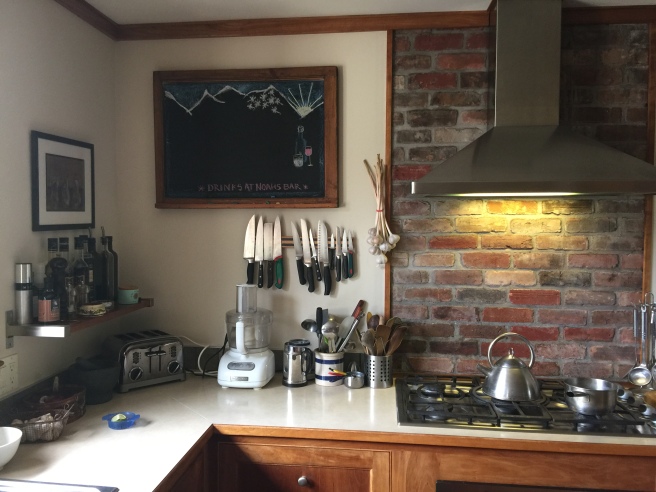
We had family visiting last weekend and I was appreciating once again how well the kitchen works. It is not the biggest kitchen nor the most modern, but it is well equipped and functional.

IMG_3062

I have a great selection of knives within arm’s length, the onions and garlic sit in baskets on the counter, and the olive oil and vinegars are an easy reach away. For me, when it comes to cooking, it’s about easy access to all the major kitchen tools. And by this, I don’t mean fancy electric machines. I thought I would show you this morning the three tools I reach for the most often when I am cooking – the ones I can’t do without.

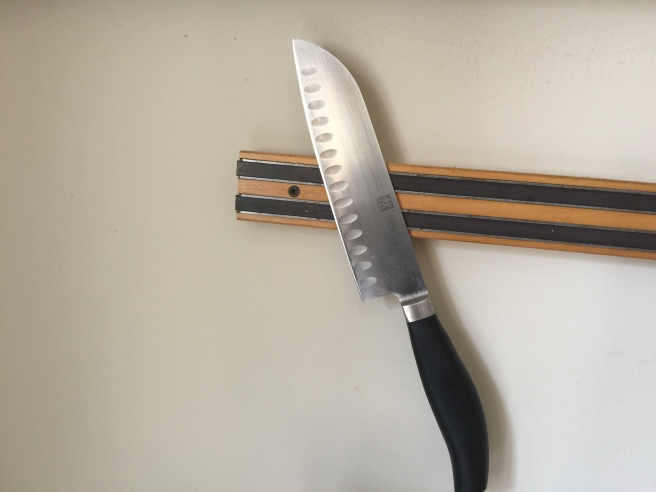
The first is my Santoku kitchen knife.

IMG_3063.JPGThis one is a Henckel 7 inch and is lightweight and always sharp. These knives come in different qualities and at different prices. You use a knife every day, so I would recommend buying the best quality one that you can afford. (That said, I have used cheaper knives that also seem to work just fine.) This Santoku seems to satisfy most of my cutting needs. My advice is to find a knife that works for you. There are many great knives out there, but it has to have a comfortable grip and be the right weight for you. When you find your knife, you won’t look back!
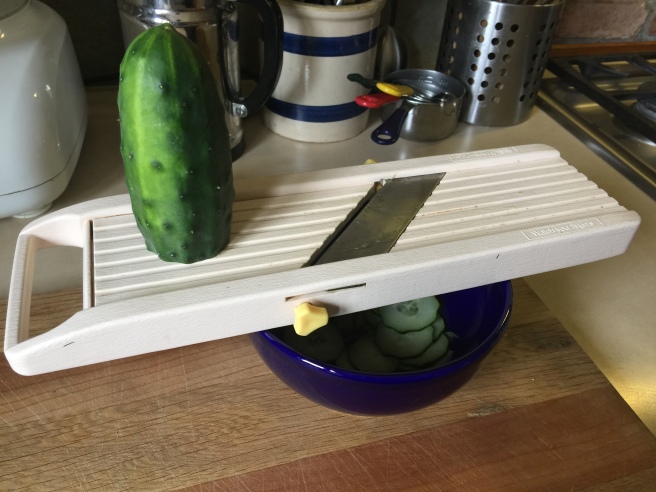
I use this Japanese Benriner mandoline every day.

IMG_3064.JPG

It lives in the drawer below the counter and is simplicity itself: small, portable and easy to clean. I bought it years ago at a Chinese grocery store (Kim Phat for those who might be reading in the Montreal area), but you can order them online at Amazon. I know there are lots of fancier ones on the market, but again I return to my theme of simplicity. They come with multiple blades, but I seem to only use the slicer and it can be easily adjusted for thicker or thinner cuts. I use it to cut cucumbers, onions, radishes, fennel and anything else that requires thin slicing. I also use it to slice potatoes for scalloped potatoes and cabbage for coleslaw. It comes with a plastic guard that really does need to be used, especially when you get near the bottom. The blade is sharp! They come in two widths. The one I have is the narrower of the two, but when I upgrade I will go for the little wider one.

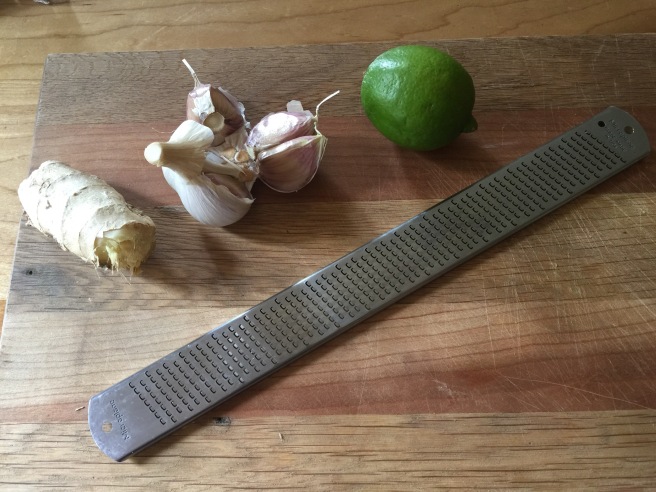
The last simple tool that I use often is this rasp that I bought at Lee Valley Tools years ago.

FullSizeRender 5

It has become a bit dull over the years. This is a testament to how often I use it. Grated parmesan on the rasp is light and airy and you’ll find you don’t need as much as when grating on the regular box grater. Bring it to the table after and allow people to grate their own. It is also a super zester for lemons and limes and makes quick work of ginger and garlic. (If you are interested in purchasing the rasp, I have included the link here.)

Voilà, three simple tools that you might not be able to live without either.

I am wondering if you have a kitchen tool you can’t live without? If so, why not share it in the comments. Maybe I’ll find a new favourite!


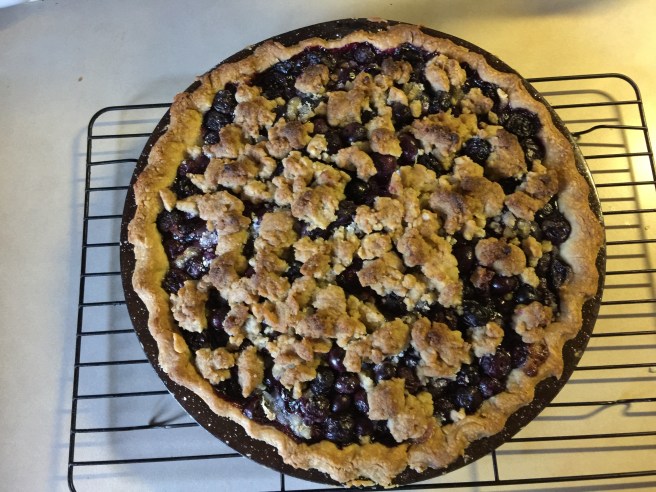
I Made a Pie…Blueberry Pie

FullSizeRender 3.jpg

It’s blueberry season here in Quebec. I always freeze blueberries for the winter, but I have never made a blueberry pie. In fact, I rarely make pies at all, so it’s a bit surprising that this summer I have made two.

My 96 year old mother asked for a  Shoo Fly pie for her birthday  this year. (This is an old Pennsylvania Dutch recipe that uses flour and molasses as its base.) My mother has been a pie maker all her life and would think nothing of making pies most days. Me…not so much. Her birthday wish forced me to revisit pie making. I felt it was the least I could do – a little pay back for all the pies she made me over the years.

The problem I have been having with pies lies in the crust. Most of the flaky pie crusts I have tasted made by country cooks are full of vegetable shortening or lard. I am not happy eating or cooking with these fats and long ago switched my allegiance to butter. The few butter crust pies I have made have not been flaky and rolling them out has been something of a nightmare. That is, until this summer.

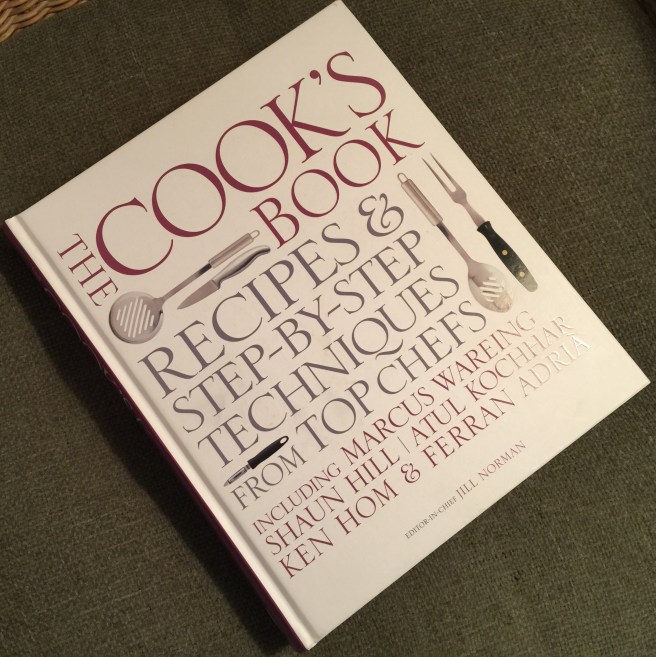
My daughter and son-in-law gave me this book a few years ago…and well, I am thinking everyone needs this book.

FullSizeRender 2.jpg

The Cook’s Book is full of techniques and recipes mastered by chefs. In this rather heavy book, I found the recipe that has altered my view of making butter crusts or  pâte brisée (shortcrust pastry). This pastry can either be made by hand or in a food processor.  For full disclosure here, I have to tell you I ran into the same problem with this recipe as I did with all of the others I have made. The recipe itself is a breeze and the dough comes together well, but like all shortcrust pastries, they call for it to be chilled in the fridge for at least two hours before rolling. This is where I broke with tradition. I recently read that it doesn’t matter when the dough is chilled – just that it be chilled before baking. I decided to roll the dough while it was still pliable and then chill it in the fridge in the pie pan. Some far better and much more experienced pastry chefs might dispute this, but all I can say is it worked for me. There was far less swearing as I was rolling out the dough and for that alone the switch-up was well worth it.

For this blueberry pie, I had only one crust, so I made it with a crumble top. I combined two online recipes  that I found for blueberry crumble pie – one from Epicurious and one from Allrecipes. I used the filling recipe and the baking temperature and time  from All Recipes and the crumble topping from Epicurious.  It turned out well. The crust was flaky and the pie delicious.

I just might turn into a pie maker after all.

L’heure Bleue

I have just recently been introduced to the French term l’heure bleue. L’heure bleue rolls off the tongue and sounds romantic, and magical, and a bit mysterious. As it turns out, that is exactly what it is. It is said that flowers are more fragrant and birds sing more sweetly during this hour of the day. L’heure bleue, translated as the blue hour, is that time early in the dawn or late in the dusk when the sun is still below the horizon and its indirect light takes on a blue shade. In the morning, l’heure bleue is followed by the golden hour when the landscape becomes bathed in golden light. This is reversed at dusk when the golden hour is followed by l’heure bleue.

It just so happens that these are my two very favourite times of day, so I am often outside marvelling in them, or if I am lucky, capturing a photo of the magic they weave. Even though they are referred to as hours they are actually a brief forty minutes in length.

I have just started exploring photographing l’heure blue even though I know it on a visceral level from all my evening walks.

IMG_2056.JPGPhotographing a full moon during l’heure bleue.

IMG_2390A spring walk.

IMG_2927.JPGA photograph from last night’s walk.

If you are in any doubt about l’heure bleue,  listen for the birds!

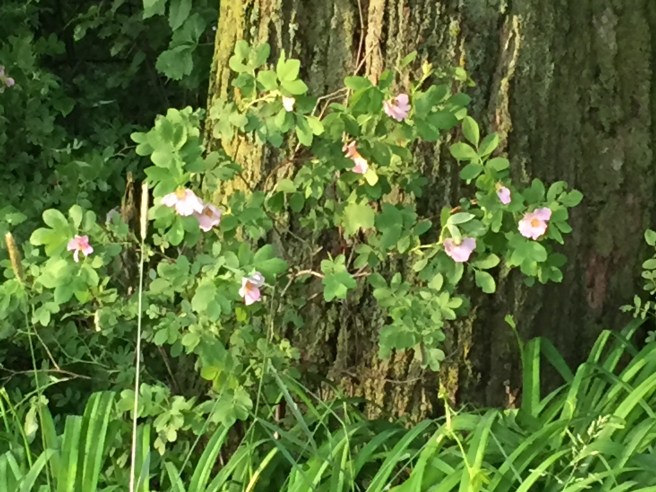
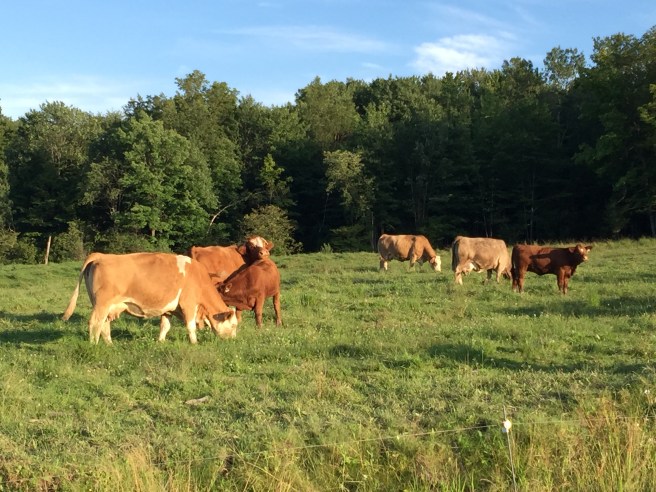
Golden hour which just precedes l’heure bleue in the evening has a very different quality of light. Everything seems to be bathed in gold.

IMG_2712Roses on Solstice Eve.

IMG_2899.JPGCows enjoying the golden hour.

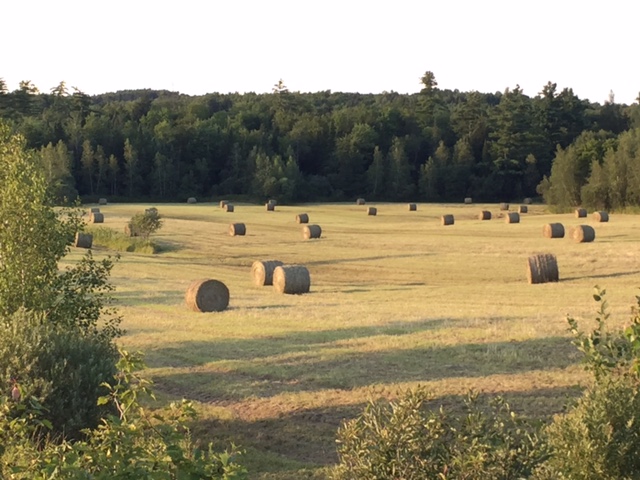
IMG_1142Golden hay bales.

Golden hour and l’heure bleue have two very different feelings and qualities of light.  Both very special. Both worth being out there enjoying.


Pot Luck Star

I have been a bit of a pot luck star this summer and I’m going to make you one too. Our summer gatherings here in the country tend to be pot lucks. It is an easy, affordable way for people to gather for a meal on a warm summer evening. Except for this year, I have been much more likely to bring something savoury to share rather than something sweet. That all changed when I intercepted this recipe being shared online by Canadian cook, Laura Calder, who self confessed that she couldn’t stop making them. Of course, that piqued my interest and the total simplicity of the recipe settled it for me. Since making these cookies, I have noticed that there are a number of different variations online. Some of them use salt, vanilla extract and cream of tartar,  but I find this recipe is just fine as is. I like adding the unsweetened sifted cocoa because it does seem to cut the sweetness a bit. Enjoy!

IMG_2887 Chocolate Chip Meringues (photo credit kd7167)


Chocolate Chip Meringues

Ingredients:

3 egg whites

1 cup of sugar

2 T sifted cocoa

170 g dark chocolate chips

Optional: small handful or scant 1/4 cup of roasted sliced almonds

Directions:

Whip 3 egg whites while beating in a cup of sugar a spoonful at a time. The mixture should become thick and glossy. (This usually takes about 8 minutes.) The mixture shouldn’t taste granular at this point. Fold in the sifted cocoa, the chocolate chips and the nuts if you choose to do so. Drop by spoonfuls onto parchment lined cookie sheets.

Bake at 275 for 35 minutes. 


A Wee Garden Tour

IMG_2575.JPGThe early morning sun shines on the vegetable garden.

We have a small vegetable garden close to the house that I often refer to as a kitchen garden. There are a number of great reasons to have a garden close to the house: ease of picking is one and the second being that we don’t need a fence to keep the deer from having a feast every night. The tall onion-like plants you see growing are the garlic that we planted last fall. They will be harvested when they start to yellow at the end of July. The tunnel is covering kale and broccoli plants.  They are hardy and don’t need the covering for warmth, but we are trying to keep the flea beetles from devastating them. Whatever we can’t grow in this garden we buy from organic growers in the area.

This garden is small by our standards because in the 1980’s we grew a few acres of vegetables in the sunlit field you see in the background of this photo. But that is a story for another time.

IMG_2612And, yes, we have flowers. Lots and lots of flowers.

Our  flower gardens grew and expanded as we landscaped and tweaked the front of the house. We now have perennial flower gardens bordering the walkway leading to the house and beyond to a cliffside deck.

IMG_2623.JPG

All of the shade loving plants had to go somewhere so we created another border on the shadier side of the lawn. The hostas loved the cold, rainy spring we had this year.

IMG_1018

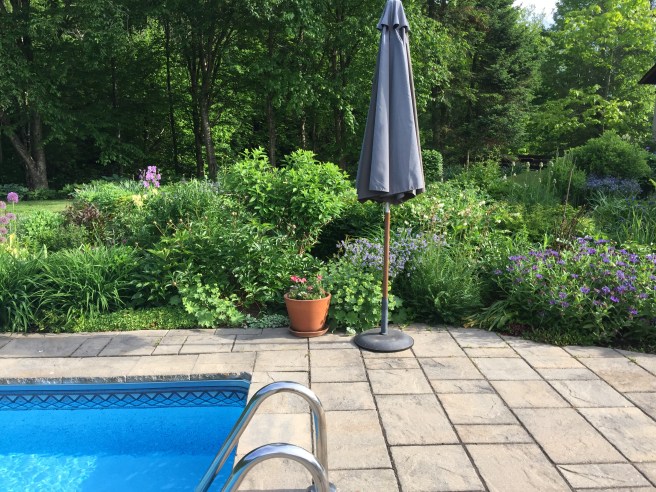
We also have a pool so adding more flowers there just seemed a natural landscaping solution at the time.  Add to that pots and planters and the walled garden by the driveway and you have a whole summer’s worth of beauty…and work!

IMG_2627.JPG

Most days in the garden start and end at the brook: perfect for washing off muddy hands and feet. And for giving thanks.

IMG_2649.JPG