What Will You Be Doing This Fresh Morning?

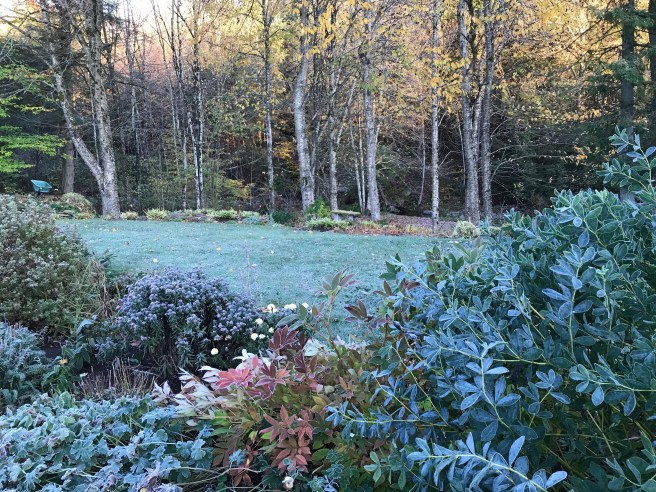
I am up at sunrise on this clear and frosty October morning, as I am many mornings. It’s the first time the frost has been heavy enough to be noticeable on the landscape and I feel as frosty as the fields.

IMG_2011.JPG

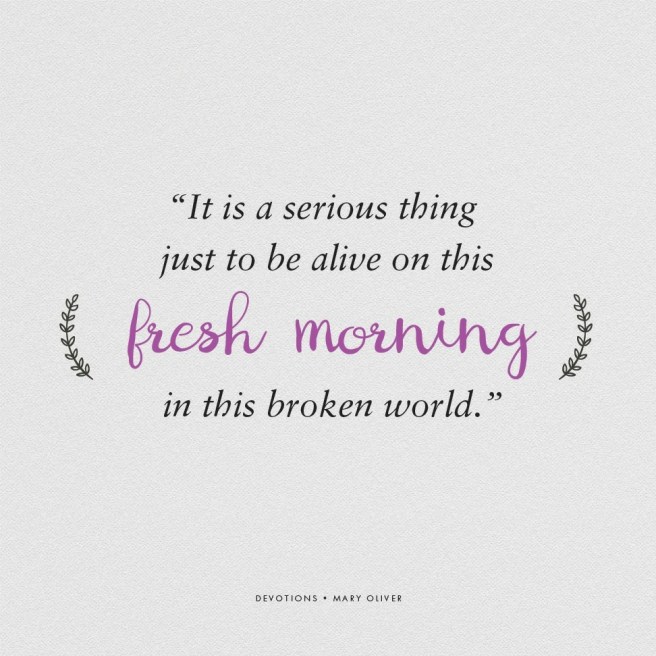
I am thinking, as I sit in the morning light, about this poem by Mary Oliver that I saw posted the other day.
IMG_0477.JPG

There is such a paradox between the serious business of being alive in a broken world and the fresh morning. Mary Oliver makes sure we notice this. She dresses the words “fresh morning” in purple and types them in an optimistic cursive script.  I have come to understand that to live in this world, maybe especially now, we have to be comfortable living with paradox. The world is broken and the day is fresh. What are we going to make of it?

Just as I am reflecting on the “brokenness of the world,”  I see the reflection of a flock of geese flying overhead in the still pinkish sky mirrored on my computer screen. The geese aren’t reflecting on the brokenness of the world at this moment. They are connecting to an ancient rhythm that sings to them about catching the northerly air flow on its way south.  It’s an old song about the ways of the world and survival.

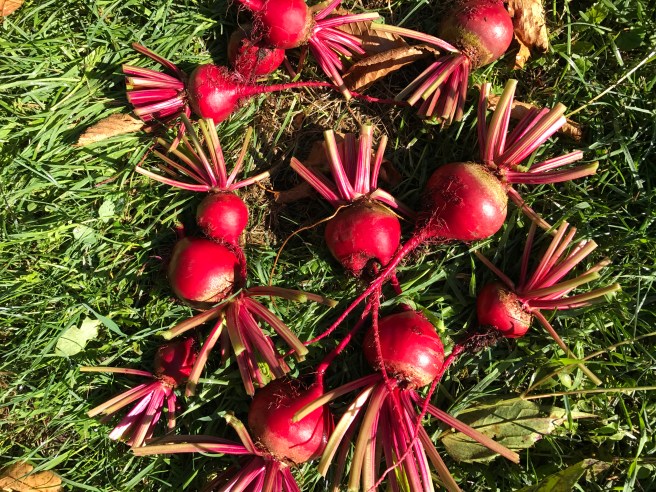
I think I’ll take my cues from Mary Oliver and the geese today. There are beets to harvest,
IMG_0485.JPG

gardens to cut back before the winter snows,
IMG_7161.JPG

…and seeds of all different sorts to sow.

What will you be doing on this fresh morning?

Is That Thanksgiving Knocking?

Thanksgiving in Canada is always in the beginning of October and it always catches me by surprise. Usually the leaves reaching their peak colour are my visual cue, but this year for some reason, maybe the wet summer and late in the season hot/dry spell, the leaves are mostly still greenish with shades of brown and red spattered in. All this to say, I’m not ready, as usual.

IMG_0401.JPG

The interesting thing about living in Québec is that Thanksgiving is not really a holiday that the Québécois celebrate. I remember teaching English as a second language one year at this time and, by way of making conversation, I asked my adult students how they were planning on celebrating the holiday. One of them said they were going to wash their windows and another that they would be getting their firewood in. “But…what will you be eating?” I persisted.

“The usual,” was my answer. They even looked a  little quizzical that I would be asking such a question. I was a bit dumbfounded. I have been living in this province many, many years and I had no idea my neighbours weren’t celebrating in the same ways we were.

I guess it’s time to muster the Thanksgiving spirit and do a little decorating, bake a pie, buy a turkey…

IMG_0404

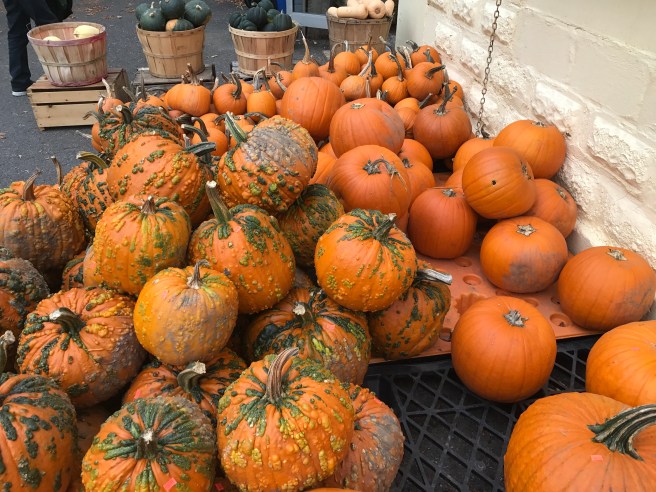
I thought I would start by buying a pumpkin since we don’t grow them ourselves. I’m really not sure about these green, warty ones. I chose the one in the foreground with the stem. I really like that classic pumpkin look. While I was here at the wholesalers, I also picked up a few apples in case I decide to make a head start on the pie.

IMG_0408.JPG

I bought honey crisp for eating and a few cortlands to make the pie. I don’t eat apples at any other time of the year  because I only like them when they are at  their ripest best.

Now for the turkey. Time to call Farm to Table and hope I’m not too late.

Or  I could just be like my Québécoise friend and wash my windows instead.

Seven Lessons In Seven Days

I wrote a few months back about seven things I learned in seven days to help me make sense of a hard week I had experienced. It was cathartic and fun, and I thought about revisiting it from time to time. So here it is, the second instalment of Seven In Seven.

Seven Things I learned In Seven Days

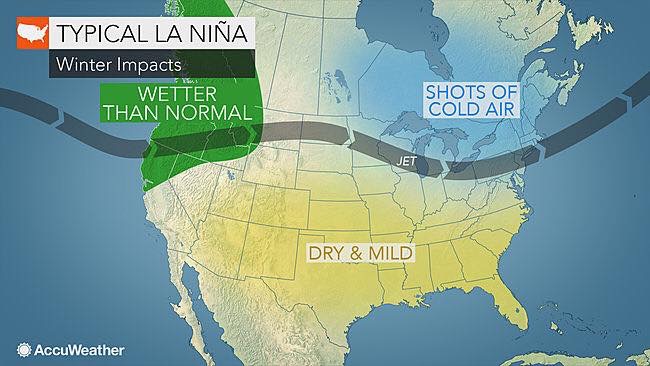
  1. October is much different than September here in southern Canada. All signs point northward. (The Big Dipper hangs low in the northwestern sky on our after dinner walks that now take place in the dark, the jet stream shifts, pulling cold arctic air down into our area, and north winds make me walk faster and pull my coat closer.)IMG_0396        See where it says shots of cold air. That’s us.
  2. I have a lot of expectations. I expect a lot of myself and others, but there is more. I also have expectations of how things should unfold, how meals should taste, how work should proceed. It is unrealistic and sets me up for disappointment. I have decided to expect less and love more. (I have been practicing for about a week now and it’s working. The present moment is usually a very fine and adequate place, if we allow ourselves to be there.)
  3. It’s a good idea to have working radar if you’re sailing in the fog near a ferry lane.IMG_0387
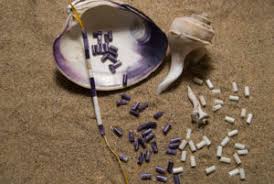
  4. On a recent visit to Martha’s Vineyard I discovered wampum. Wampum are beads made by the Wampanoag (Eastern Band Cherokee) of Aquinnah from the quahog, a hard shelled, purple and white clam. The Wampanoag fashion these beads into bracelets and earrings and belts. I am still thinking about my friend’s bracelet that just spoke of the sea to me.                        images
  5. Prince Harry is a very good motivational speaker. I just watched his closing speech for the Invictus Games. We can all do amazing things…and should.
  6. Yes, there is such a thing as a fogbow. IMG_3536
  7. I feel numb (Las Vegas). I feel badly about my numbness, but I don’t know how to respond anymore. These events just seem inevitable given the refusal to investigate these tragedies as rigorously as we do plane crashes or terrorist attacks and to take measures to prevent them from happening again. My heart breaks for all those families who will never be the same because on a warm night in October some members decided to go and enjoy an outdoor country music concert.

Release…Mexico Bound!

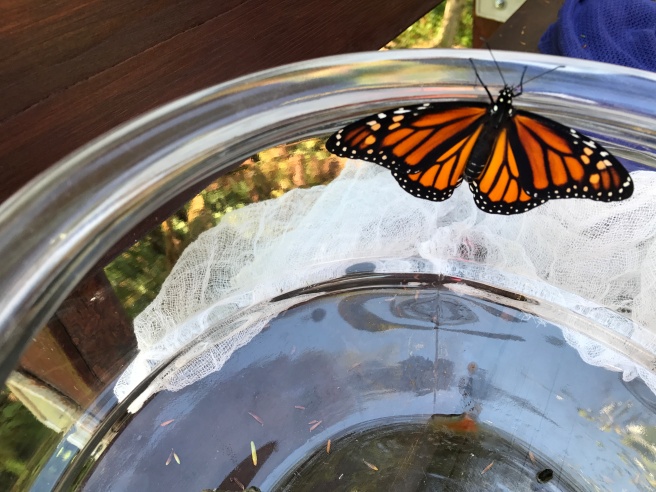
IMG_0325It took a few hours for her to show some interest in leaving the glass bowl that had been her home for the last month. Fanning her wings and inching her way to the top of the rim were the first signs.
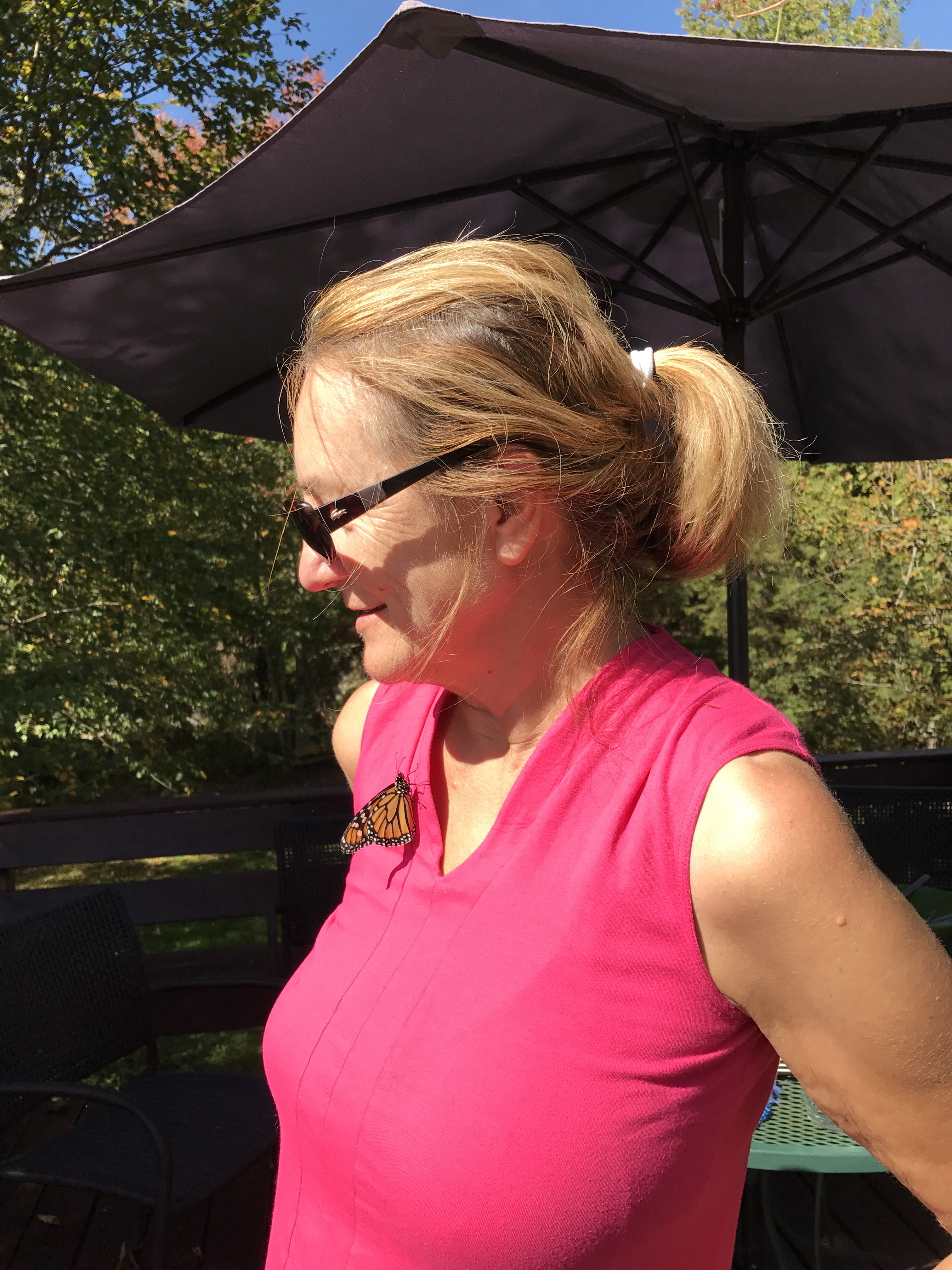
I took her to the outside deck. It was the perfect fall day for the release, warm and calm.

IMG_0331

IMG_0339.JPGAnd…she made a surprise landing before her final departure.
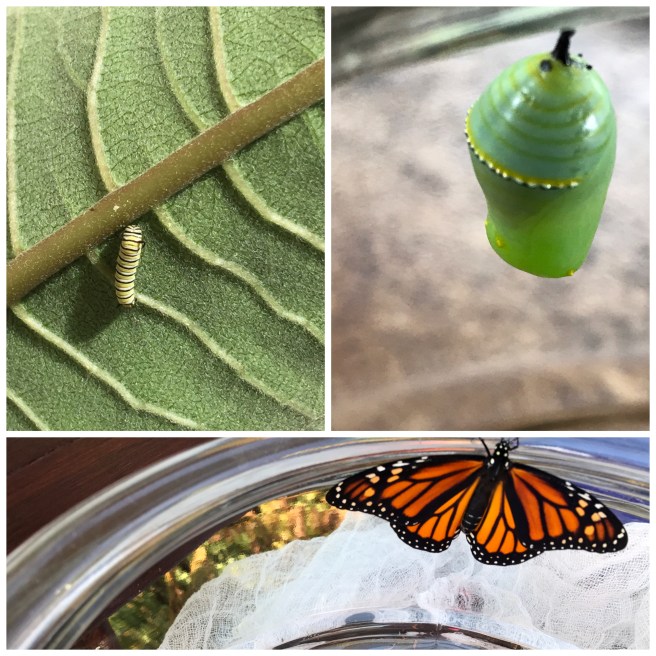
Looking back on the last month, there were a few highlights. Finding the caterpillar was definitely an exciting day. The milkweed is more abundant here than in previous years, but it still required looking at many, many plants before I finally found her.

IMG_0356.JPGThe second experience that took me a bit by surprise was my emotional reaction when she finally encased herself in the pupa. One day she was in her caterpillar body and then she was gone. It felt like a loss, and I wasn’t prepared for not seeing her anymore in the same ways.
I felt such joy when she finally emerged, especially when she  fanned her wings and I could see her in her full beauty. But I need to say something here about joy. Brené Brown, the social scientist who presently has a book on the New York Times bestseller list, talks about joy being the most vulnerable emotion we experience. “We’re afraid,” she writes, “that if we allow ourselves to feel it, we’ll get blindsided by disaster or disappointment. That’s why,” she continues, “that in moments of real joy, many of us dress rehearse tragedy.” This helps to explain why, as I saw her sitting on the pine branch, I imagined a giant bird, maybe a heron, swooping down and grabbing her. I also knew, however, that the antidote to this kind of thinking is gratitude, and the butterfly and I had lots to be grateful for. She brought me, and by extension you, many moments of wonder as this whole process unfolded. It also turns out that if I hadn’t found her and moved her inside she would have died when the farmer harrowed the field where she was living. There were many moments of grace, capped off by her release.

IMG_0344.JPG

Safe travels, little one!

It’s a Girl!

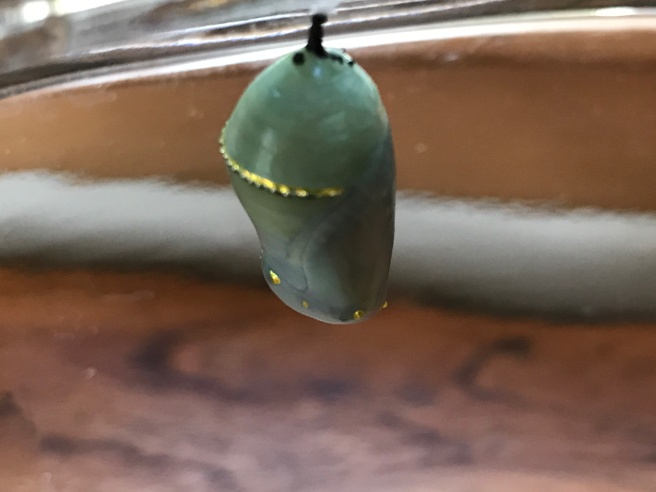
The pupa had been changing the last few days. It was turning from its original  chartreuse to this grey green. If you look closely,  you can begin to see the wings forming inside.

IMG_0304.JPG

A day later it looked like this. The body is showing clearly now through the chrysalis which has become transparent.

IMG_0309.JPG

I knew it wouldn’t be long.  I came home two hours later to this.

IMG_0310.JPG

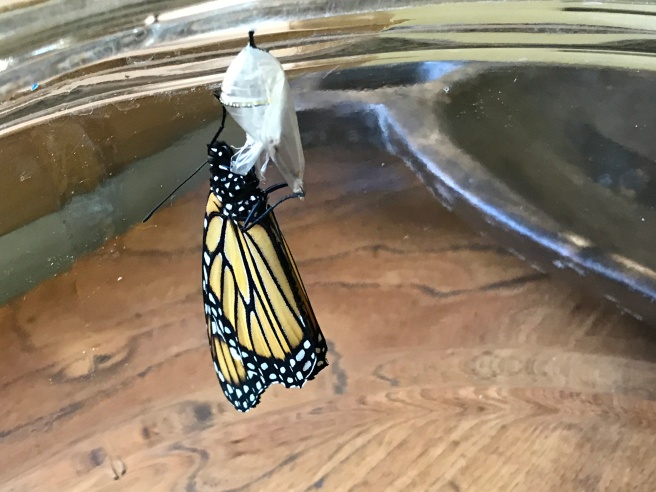
When monarchs hatch the body is quite huge, filled with a liquid that gets pumped into the wings. I missed this part. It rested quietly for a few hours and then…

IMG_0325.JPG

There she is finally stretching out her wings. She took my breath away!  I wasn’t expecting the intense, saturated colours of her wings or the joy that bubbled up from inside as I watched her. It wasn’t until she fanned her wings that I knew she was a girl. (Male monarchs have two distinctive black dots on the lower corners of the wings.)

Her release came on this same beautiful, September day but that part deserves a story of its own. I have a video to edit and some words to find that wrap up this whole adventure in raising a monarch. Stay tuned.


The Well

IMG_0196.JPG

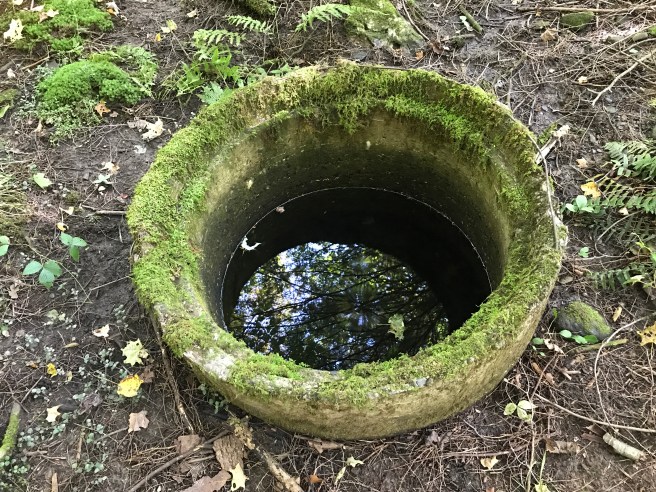
I came across this old well in the woods the other day.  I stopped and looked at it for a long time, mesmerized  by the dark water and the green mosses that have made their home along its rim. Our relationship with water is so primal.

This spring provided the water to a cabin that used to be on the land next door sixty years ago.  It is not that easy to get to this well, so it must have taken some searching and ingenuity. For starters, they had to get the water from here across a mountain brook that is often just a trickle but can also be impassable at times. Finding a good water source dictated where you could live and build your home here in the country and was always the first order of business.

Water….finding it, keeping it clean, preserving it, has always been serious business.  But it  has also inspired a rich history of story telling.

***********

Wells have inspired stories from the beginning of time. Many fairy tales use their dark depths to bring something of importance to the surface. From the Frog Prince:

In olden times, when wishing still did some good, there lived a king whose daughters were all beautiful, but the youngest was so beautiful that the sun itself, who, indeed, has seen so much, marveled every time it shone upon her face. In the vicinity of the king’s castle there was a large, dark forest, and in this forest, beneath an old linden tree, there was a well.

Don’t you just love the line, “In olden times when wishing still did some good…?”

In many fairy tales something that at first seems dark and sinister emerges from the well. In the above case, an ugly frog who offers to help the princess – but, of course, wants something in return.

One theory for wells always housing fearful beings in fairy tales is that parents in times gone by conjured up these dark forces living in wells to scare their children in order to keep them far away from the very real dangers that wells presented.

Wells were also revered. They were sought out for contemplation and for making wishes. (I am thinking that wishes in days gone by were more like prayers.) The idea that a wish could be granted came from the notion that water was the home of deities or had been placed there as a gift from the gods.  And in many areas of the world where water is scarce or unclean it must have truly felt like a gift from the gods to come upon a well.

Maybe most importantly, wells  were community gathering places. It was here that life unfolded, and stories were told, and life became meaningful because of the sharing.

My question is, how do we revive the tradition of the well as gathering place?  In this time in the world when there is so much divisiveness it seems to me we could all use a well in our communities to come together and share what we have in common instead of what divides.


Conkers, Brights, Shiners, Cheggies, Obblyonkers,Cheeses


fullsizeoutput_27c.jpeg

Gawd, the Brits have the best words for EVERYTHING! In the American midwest they call them buckeyes. Not to be outdone by the Brits, they have even come up with a peanut butter and chocolate candy made to look like the nut – also called a buckeye. In this part of the world we just call them chestnuts or, if we’re being really fancy, horse chestnuts.

There’s something about chestnuts that take me back to a simpler time – not necessarily a better time, but simpler. Sometimes I wonder if these times were simpler just because I was a child. My parents might have a very different story to tell.

IMG_0285Drilling holes in chestnuts to make necklaces or to play conkers is stored in my memory bank in the same file as wild bicycle chases playing  “cops and robbers” and games of hide-and-seek lasting long after dark with the neighbourhood kids.

These games seemed to have met the same fate as the chestnut trees in North America. At one point, 25% of the forest here in the Appalachian range was comprised of chestnut trees.  In the early 1900’s a chestnut blight ravaged the forests and now there are very few old specimens left.

I have had two chestnut trees play a role in my life. One was in my hometown watched over guarded by an old lady called Mrs. Moody. (I couldn’t make up a better name if I tried.) The other is a lone surviving tree by an old foundation up the road from where I live now.

I feel the same way about the chestnuts as I do the bats that also got decimated by a fungus. There are now only two bats on our road which swoop over our heads on evening walks when in my childhood the air was full of them.

I’m wondering if I’m hanging  onto these memories because it’s a good thing to wish for survival of a species or if it’s just hard to say goodbye to what once was.


The Crickets Sing a Song of Sadness and Change

“The crickets felt it was their duty to warn everybody that summertime cannot last for ever. Even on the most beautiful days in the whole year – the days when summer is changing into autumn – the crickets spread the rumour of sadness and change.”  (From Charlotte’s Web by E.B. White)

The crickets I captured today on video seem to have an urgent message for you.


I think they may be telling you to  put down whatever you’re doing and enjoy these last days of summer.


Metamorphosis

One day he is there in his caterpillar body hanging from the lip of the glass jar that has been his home for the last two weeks, and then he is not. It’s a death of sorts and has me feeling mournful for his loss this morning.

IMG_0092You can see him attached and suspended in the J position.

He had been acting differently for about three days. He stopped eating and moved to the top of his glass jar. He stayed in a horizontal position there for a day or two until he suspended himself yesterday.

This is the scene this morning.

IMG_0118.JPG

Lack of appetite and failure to move are maybe the first signs a death/transformation are imminent for caterpillars…. and for humans too. Can’t help but think of the similarities. I am wondering if in the last three days he had been sensing that some big change was about to happen. Certainly his body was giving him signals.

I find myself trying to imagine the organic shiftings that are happening within the chrysalis at this moment: cells rearranging themselves, tissues dissolving and reforming. On the outside all looks quiet. He has pulled himself in and shut out the world. His home for the next two weeks this beautiful yellow/green orb with gold dots sprinkled around the top.

This is the universal story of  death/rebirth coming to you from a glass jar on a screen porch. We are now in that quiet place, removed from the world, encased in a protective shell, waiting on the work of  forces far greater than anything we could ever dream possible.  It’s a miracle really.


Fences Make Good Neighbours

I have been thinking a lot about boundaries lately. Mostly because we have a new piece of land that borders on a neighbour to the southwest and our new full time neighbour to the north.  Boundaries are never really an issue until they become one and I suspect this holds just as true for property boundaries as for personal boundaries. In the spirit of being respectful of boundaries, we have decided to discover ours.

There is an old saying about fences making good neighbours, so this seemed like a logical first step in discovering our boundaries. We have had no need for fences on our land since we have lived here because we do not raise animals, but in years gone by people put up fences to demarcate their land whether they were raising animals or not. We have discovered pieces of the old fence over the years and yesterday decided to follow one of these lines to the end point which separates our land from the land next door.

IMG_0095.JPG

About seventy-five to a hundred years ago the fencer on our land used the trees growing in the woods as fence posts and tacked the wire to all the trees which lined up (approximately) with the boundary. As trees will do, they grew and as they grew the wire became embedded in the centre of the tree. To find our boundary we had to look for old pieces of wire coming out of large trees like this one, or look for it in dead or fallen trees on the ground.

As it turns out, our boundary is not at all where we thought it was.  Can’t help but wondering if this is the same problem with personal boundaries. Humm….

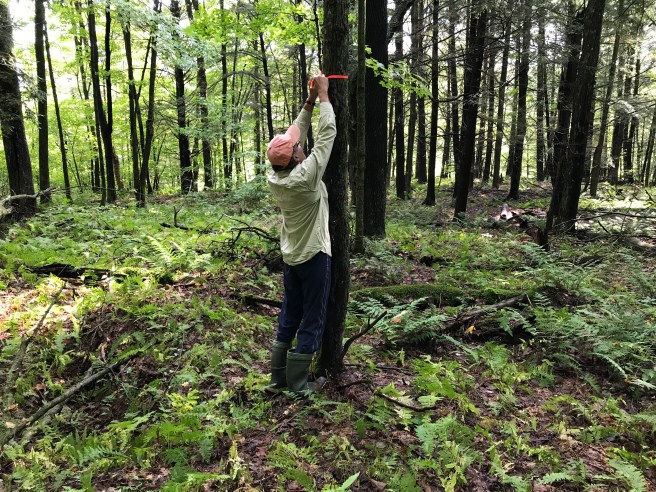
We marked all of the trees along this one line.

IMG_0099.JPG

When we got to the uppermost point, we discovered two things. Our neighbour to the north has become as interested in boundaries as we are. He has marked all the trees on our new tract of land that borders his property with the same orange ribbons. He is making hiking/ski trails and doesn’t want to be cutting trees on any land that is not his. (He’s a great neighbour!)  We also came across a wildlife camera belonging to another neighbour who has been hunting on our land for years. It’s strange to be this far back in the woods and see so many signs of human activity.

IMG_0103.JPG

Our boundary marking/discovering has been far from an exact science, but it sure does feel good to have a clearer idea of just what land we are supposed to be stewarding. And, more importantly, what land is not ours to be making decisions about!

I have come to understand that fences do make good neighbours, something our ancestors were very clear about. And we have all the old fence wire to prove it.